
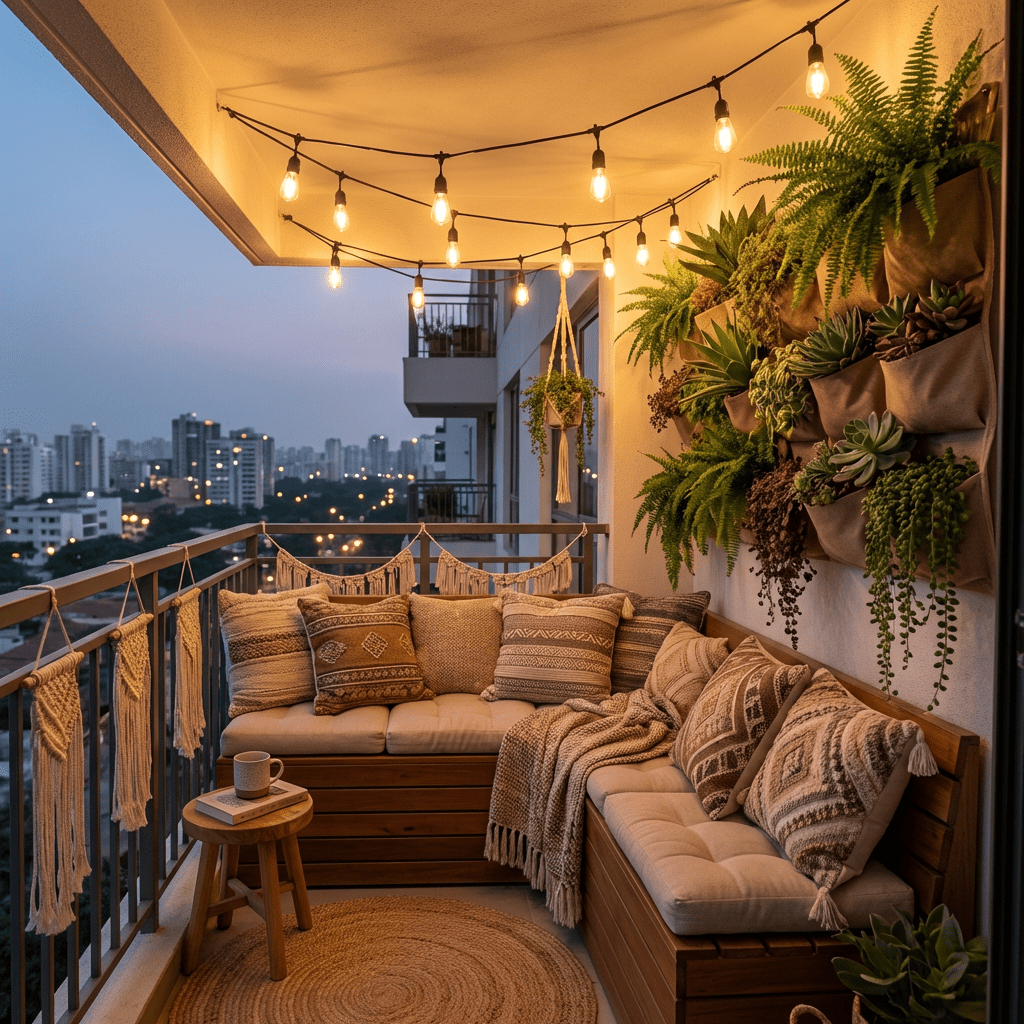
A small balcony often goes unused after sunset because there's no light out there, or only a harsh fixture by the door. A strand or two of warm string lights fixes that for $20 to $60 and makes the balcony feel like an extra room on summer evenings.
The four balconies in these photos show the main approaches: a drape under the ceiling, a curtain of lights on the back wall, a zigzag across an open balcony and a single strand along the railing. The ten ideas below cover those and six more. Before buying, check where your nearest outdoor outlet is, whether your lease allows anything fixed to the walls, and which way the wind usually blows across the balcony.
1. A drape under the ceiling
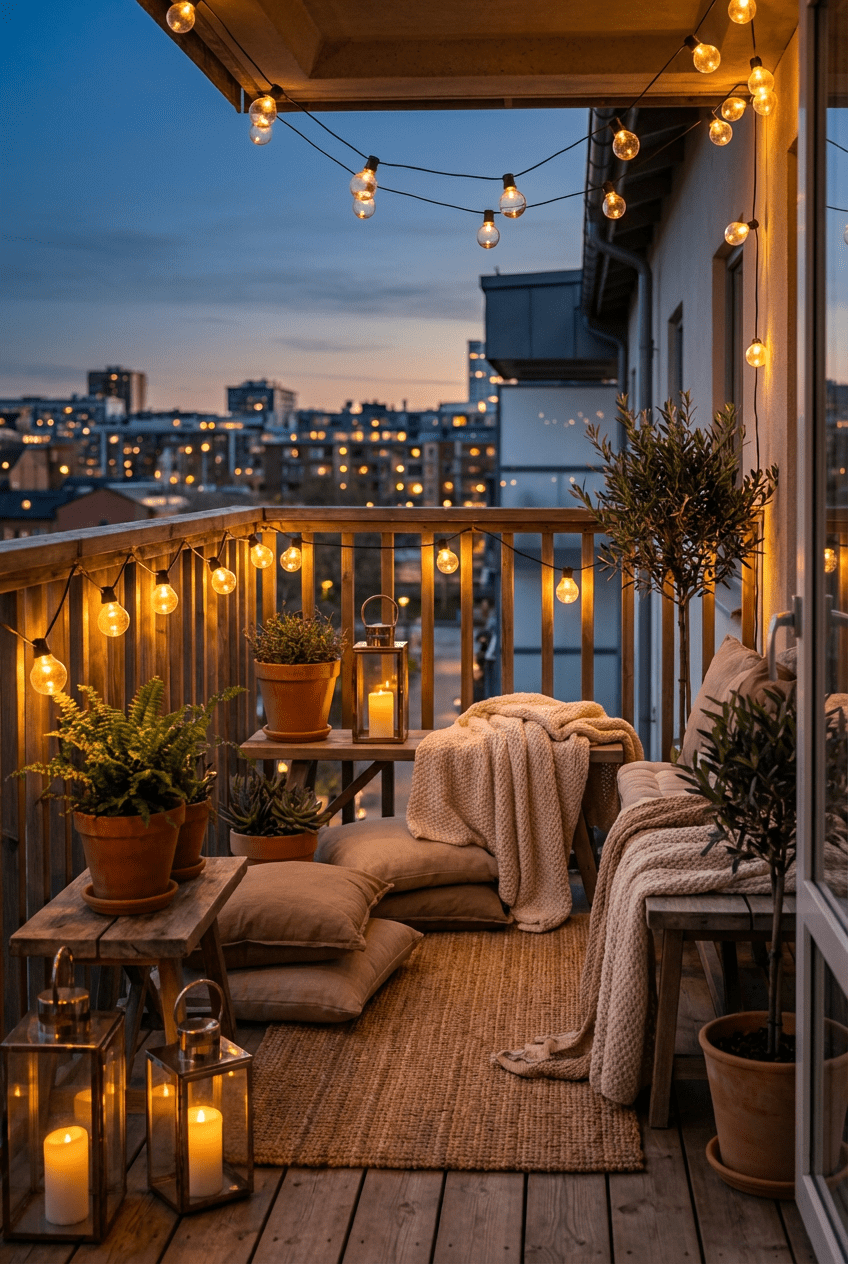
On a covered balcony, a strand of globe bulbs draped in loose swags under the ceiling, like the lights in this photo, makes the space feel like a room. A second strand along the railing adds light lower down and frames the view.
Hang the strand from small hooks every 2 to 3 feet, letting it dip 6 to 12 inches between hooks. Outdoor adhesive hooks hold lightweight strands on smooth ceilings; screw-in cup hooks are stronger but need permission in a rental.
Globe bulbs, like these, give a warm café look. LED bulbs in plastic globes are shatterproof and use far less power than glass incandescent ones.
The lanterns with candles on the floor here add a second, lower glow. Use LED candles in lanterns if your building bans open flames.
2. Curtain lights on the back wall
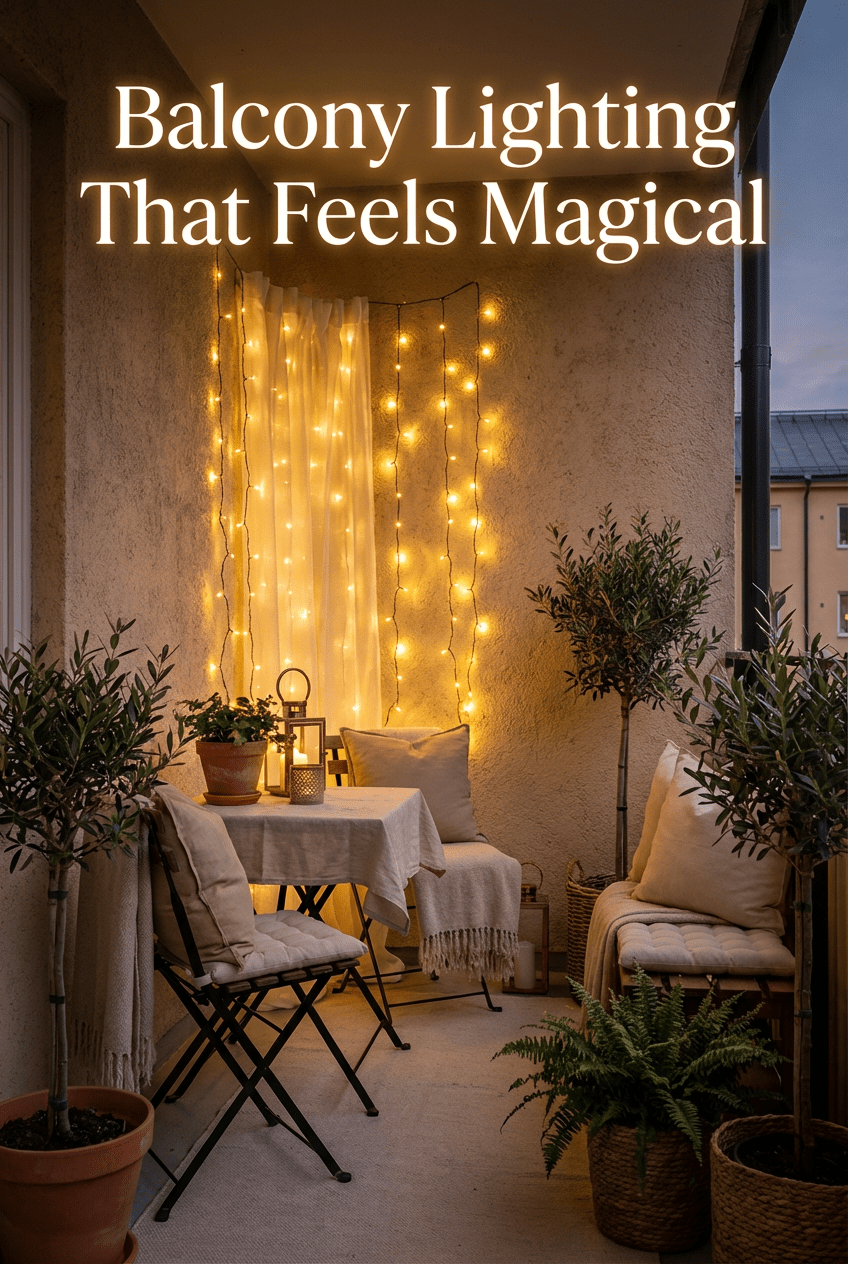
Curtain lights, many thin strands hanging from one top wire, make a wall of soft light. In this photo, they hang behind a sheer panel on the balcony's back wall, which diffuses the glow and hides the wires during the day.
Hang curtain lights from a tension rod, a curtain wire or a row of adhesive hooks along the top of the wall. Most are about 6 to 10 feet wide and 6 to 9 feet tall, which suits a single balcony wall.
Use a fabric rated for outdoor use, and only on a covered balcony where rain won't soak it. Keep LED curtain lights from touching anything that gets hot.
A small bistro set, like the folding table and chairs here, is all the furniture this kind of balcony needs.
3. A zigzag across an open balcony
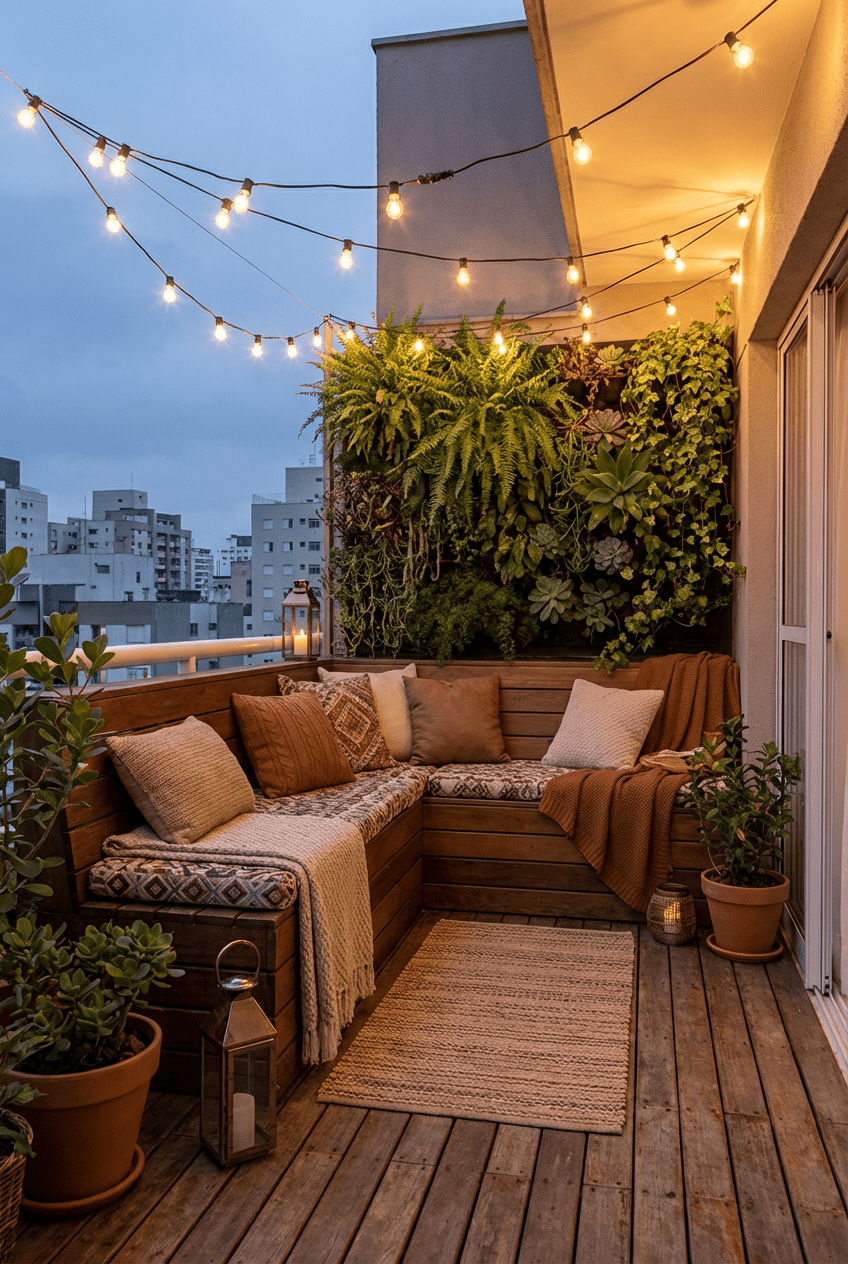
On a balcony without a roof, string lights zigzagged between two walls, like the ones in this photo, create a ceiling of light. Over a cushioned bench and a vertical garden, it makes the balcony look like a rooftop bar.
Plan the zigzag before you hang anything. Measure the distance between anchor points and buy enough length to cross three or four times with some sag. Commercial-grade strands with a steel guide wire or a separate support cable handle wind much better than light consumer strands.
Where there's nothing to attach to on one side, a weighted planter with a tall pole works as a freestanding post. Fill the planter with sand or concrete so it can't tip in wind.
Take strands down before storms, or at least check the anchors after a windy night.
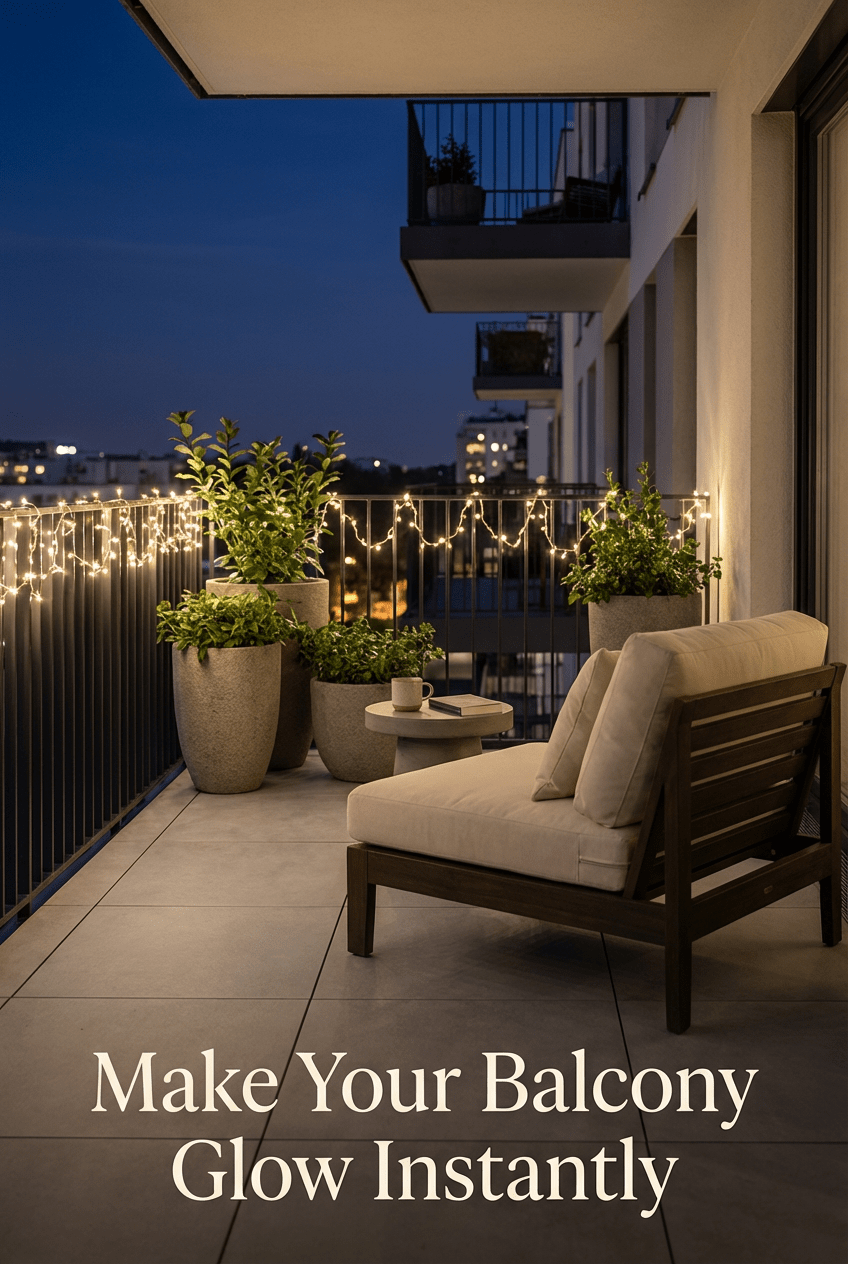
4. A single strand along the railing
The simplest option is one strand of fairy lights along the top of the railing, like the minimal balcony in this photo. It outlines the space, frames the view and leaves the ceiling clear.
Attach the strand with zip ties or outdoor clips every 12 to 18 inches, so it doesn't sag or blow loose. Keep it on the inside of the railing, since many buildings don't allow anything hanging over the outside.
Thin copper-wire fairy lights are nearly invisible by day and give a soft sparkle at night. They suit a calm, modern balcony with one or two chairs.
5. Lights in a vertical garden or trellis
Weaving fairy lights through a trellis or a plant wall, like the green wall in the third photo, lights the plants from within and makes the corner glow. It's a good way to add light without anything overhead.
Use thin copper-wire LED strands, which run cool and won't harm plants, and wind them loosely so stems can grow. Unwind them before pruning or repotting.
If the trellis is freestanding, check that the extra weight of lights and plants hasn't made it top-heavy. Tie it to the railing or a wall hook at the top if it rocks.
6. Globe lights at different heights
Hanging several short strands or individual globe lights at different heights, rather than one straight line, gives a festival feel. It works especially well in a corner or above a table.
Keep the lowest bulbs at least 7 feet above the floor, or over furniture where nobody walks, so they don't hit anyone's head.
A mix of bulb sizes looks more relaxed than identical bulbs in a row. Keep all the bulbs the same color temperature, though, or the light looks patchy.
7. Solar string lights
Solar strands skip the extension cord entirely, which helps on balconies without an outlet. A small panel charges in the sun during the day and the lights turn on at dusk.
Solar lights need four to six hours of direct sun to last through the evening, so they suit south- or west-facing balconies best. On a shaded balcony, a rechargeable battery strand that you charge indoors by USB is more reliable.
Wipe the solar panel every few weeks, since dust and pollen cut its charge noticeably, and angle it toward the sun rather than flat on the floor.
8. Lights in jars and lanterns
A short battery strand of fairy lights coiled inside a glass jar or lantern makes a small, glowing decoration for a table or the floor. The lanterns in the first photo give a similar low light.
Battery fairy lights cost a few dollars each. Choose ones with a timer, so they switch off after six hours and save batteries.
9. Lights wrapped around a potted tree
Wrapping a potted olive tree or a tall plant with fairy lights, like the small trees in these photos, makes it a soft feature at night. Spiral the strand loosely from the base up the trunk and out along the main branches.
Use only LED strands rated for outdoor use, and loosen or remove them as the plant grows so the wire doesn't cut into the bark.
Plug the strand in before you start wrapping, so you can see the spacing and fix gaps as you go.
10. Put everything on a timer
A plug-in outdoor timer or a smart outdoor plug turns the lights on at dusk and off at bedtime, so you never forget them. It also saves power and stops bulbs burning all night.
Choose an outdoor-rated timer or smart plug with a weatherproof cover. Many can follow sunset times automatically.
Set the lights to switch off by 10 or 11pm if your bedroom windows face neighbors, or check your building's quiet hours rules, which sometimes cover outdoor lighting too.
Power and safety
Use only lights labeled for outdoor use, and plug them into an outdoor outlet with GFCI protection, or a GFCI adapter. Use an outdoor-rated extension cord if the outlet isn't close, and keep plugs and connections off the floor, where rain can pool.
Check the packaging for how many strands can be connected end to end, and don't exceed it. Never staple or nail through the wire, which can damage the insulation. Inspect strands at the start of each season and throw away any with cracked wires or broken sockets.
In winter, bring indoor-only or light consumer strands inside. Our guide to winterizing a small balcony covers what to store.
Common questions
How do you hang string lights on a balcony without drilling?
Use outdoor adhesive hooks on smooth surfaces, zip ties or clips on the railing, a tension rod between two walls, or a weighted planter with a pole as a freestanding post.
Can you leave outdoor string lights up all year?
Commercial-grade outdoor strands can usually stay up, but check them after storms and each season. Lighter consumer strands last longer if you take them down in winter.
Start with one strand where you sit most, then add a second once you see how the light falls. For more balcony ideas, see our guides to summer balcony decor and tiny balcony furniture.