
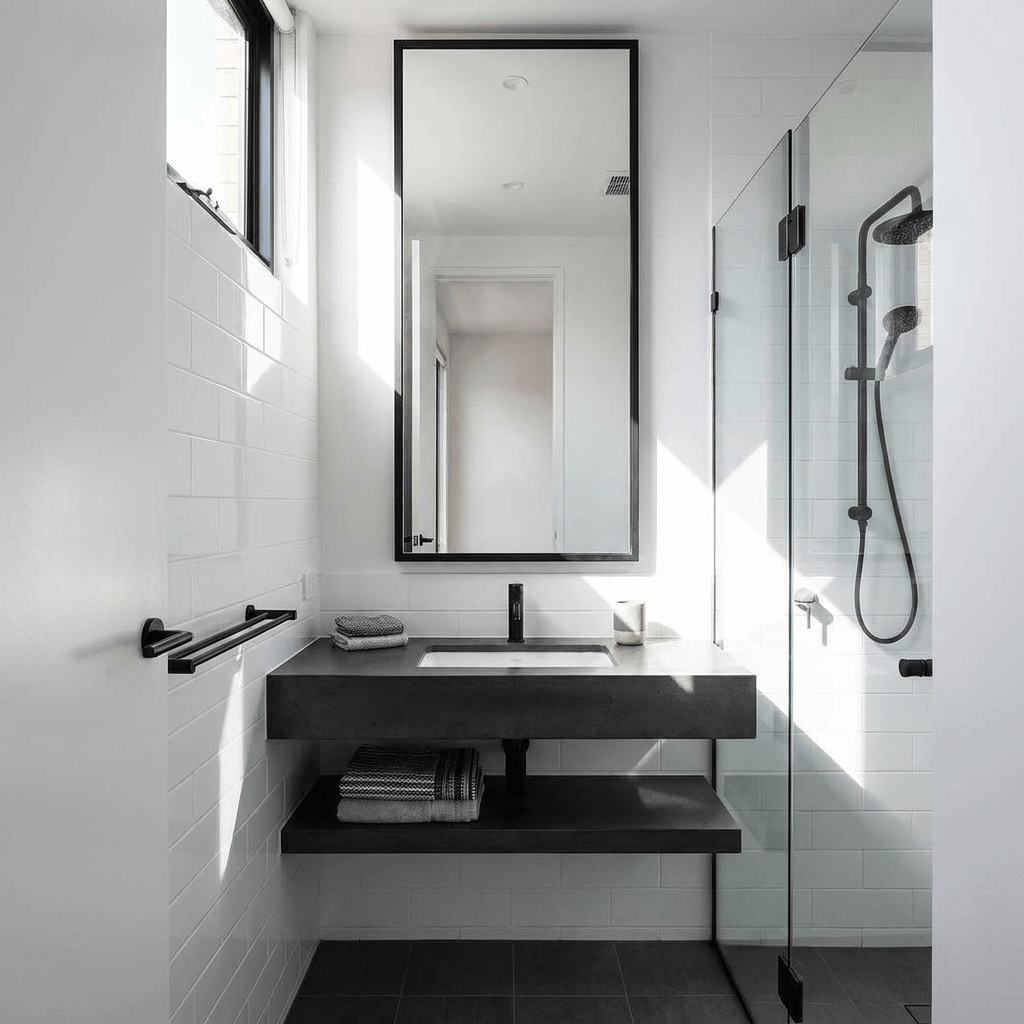
You can't add square footage to a small bathroom, but you can change how big it looks, and the mirror does more of that than anything else in the room. A larger mirror reflects more of the room and the light, so the walls seem farther away. A badly sized or badly lit one does the opposite.
The four bathrooms in these photos show the main options: a mirror that fills the wall, a round backlit mirror, a tall panel in a narrow room and a pair of framed mirrors over a double vanity. The eleven upgrades below range from a $20 LED strip to an installed LED mirror, with notes on sizes, electrical safety and what renters can do without the landlord.
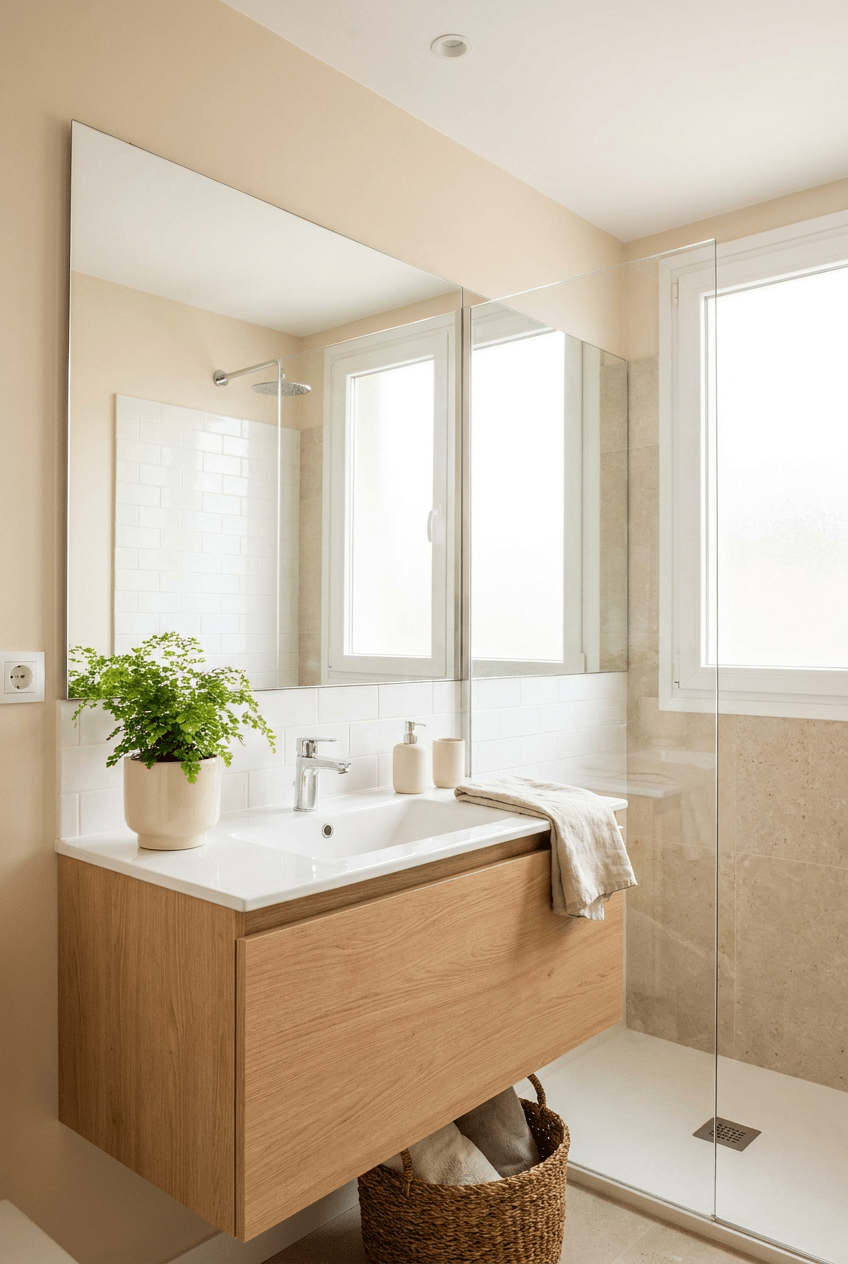
1. A frameless mirror the width of the vanity wall
A large frameless mirror that runs the full width of the wall, like the one in this photo, reflects the window and the shower and makes the room look close to twice as deep. With no frame, the edge almost disappears, which suits a small bathroom where a heavy frame would feel crowded.
Size the mirror to the vanity or the whole wall, not to your face. Leave 1 to 2 inches between the mirror and any side wall, and 3 to 6 inches above the faucet or backsplash so it stays clear of splashes.
Large plate mirrors are heavy and fragile. A glass shop can cut one to size and will usually install it with clips or a J-channel at the bottom; expect roughly $150 to $400 installed, depending on size. Choose polished edges so there's nothing sharp exposed.
Light wood vanities and pale tiles, as in this room, reflect well and keep the space bright.
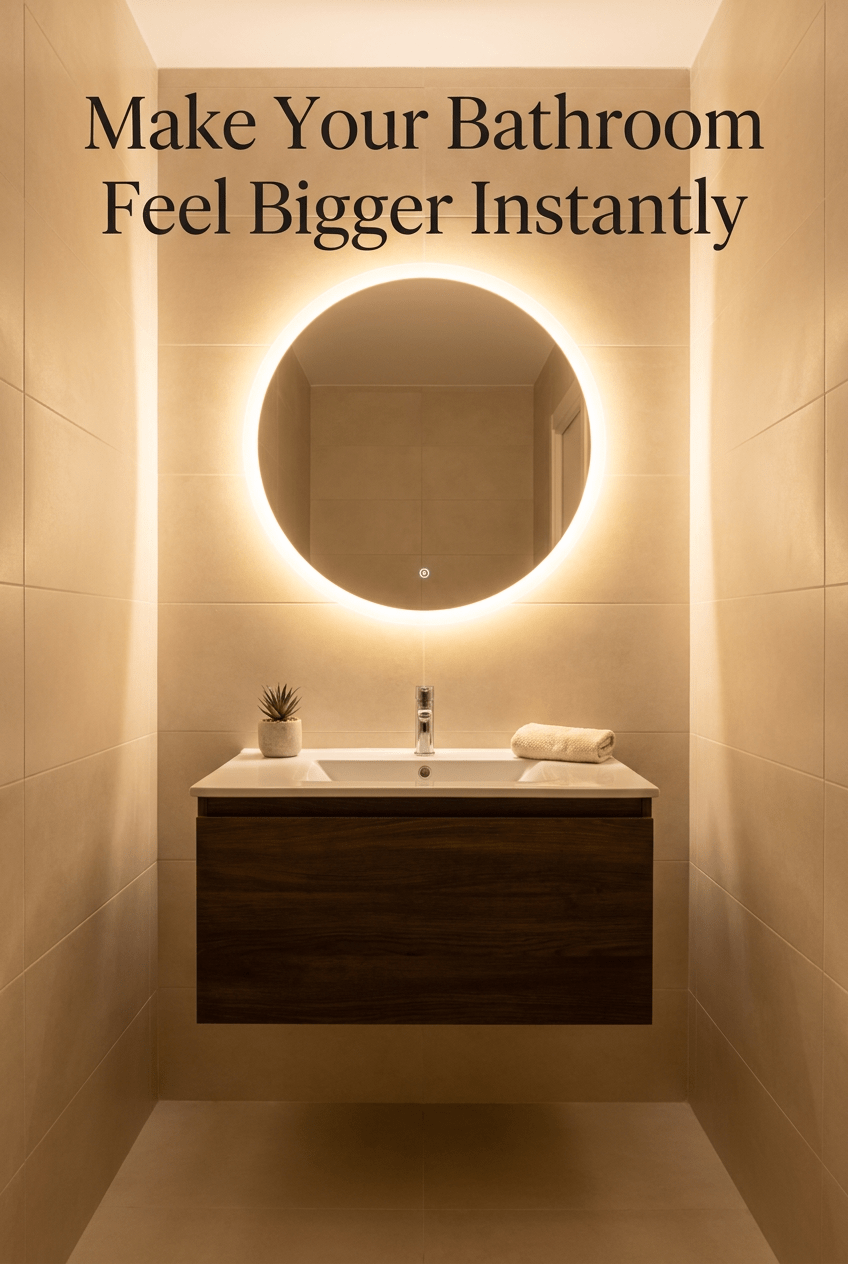
2. A backlit LED mirror
A backlit mirror, like the round one glowing in this photo, gives soft, even light around your face and adds a second light source in a room that often has only one ceiling fixture. The glow on the wall behind it also makes the wall seem to recede.
LED mirrors cost about $80 to $300. Look for one with a touch switch, a dimmer, an anti-fog pad and an IP44 rating or higher, which means it's built for bathroom moisture. A color temperature setting near 3000K looks natural for makeup and shaving.
Hardwired mirrors need to be connected by a licensed electrician to a circuit protected by a GFCI. Plug-in versions exist, but the cord has to reach an outlet and shouldn't hang near the sink. In a rental, ask before hardwiring anything.
A round mirror like this one suits a narrow vanity, since it softens the straight lines of tiles and cabinets.
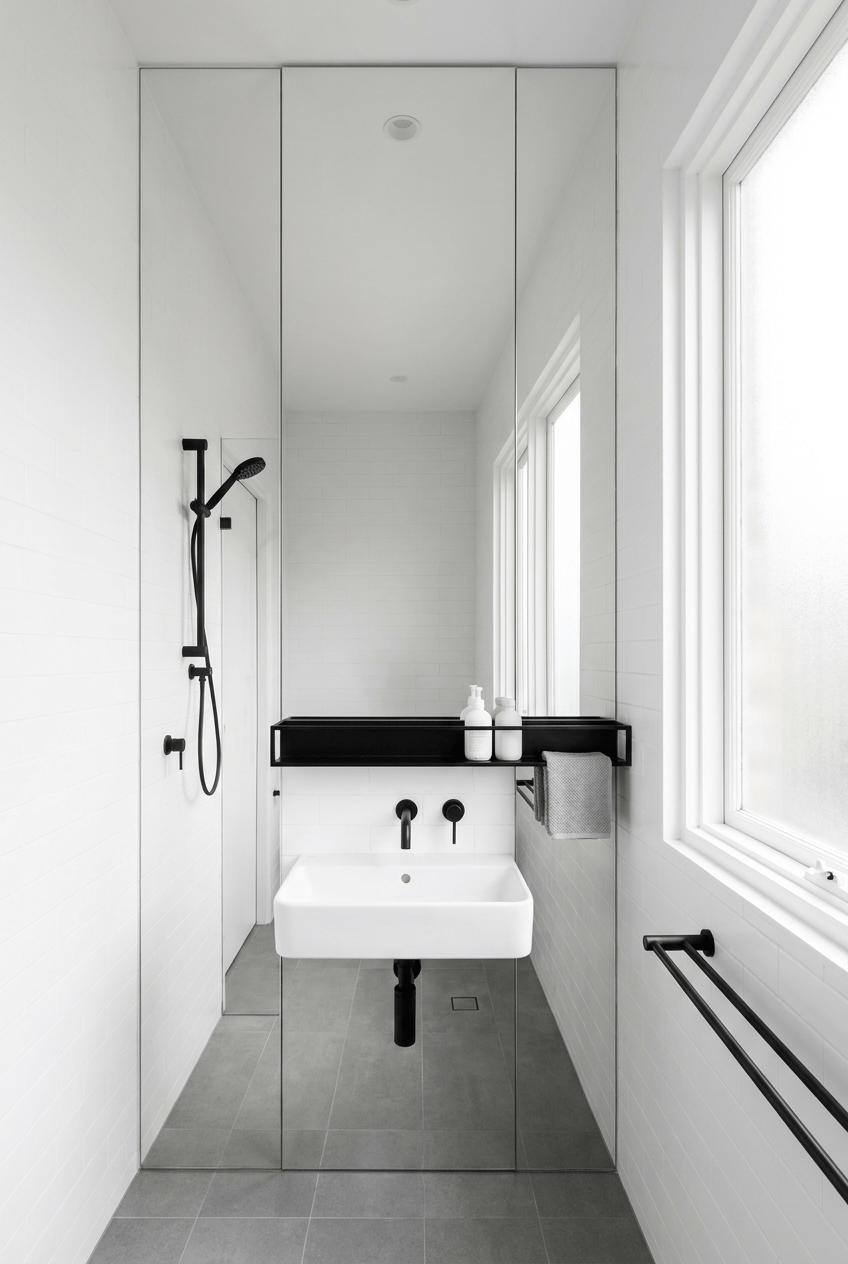
3. A tall mirror in a narrow bathroom
In a long, narrow bathroom, a mirror that runs from the sink nearly to the ceiling, like the panel in this photo, draws the eye up and doubles the room's length in reflection. The wall-mounted sink and the slim black shelf keep the floor clear, so the reflection shows open space rather than clutter.
A floor-to-ceiling mirror like this one is a job for a glass installer. A cheaper version is a tall rectangular mirror, about 24 by 60 inches, hung vertically above the sink.
Keep what's reflected tidy. A mirror shows everything opposite it twice, so a cluttered shelf or a towel heap across the room looks twice as bad.
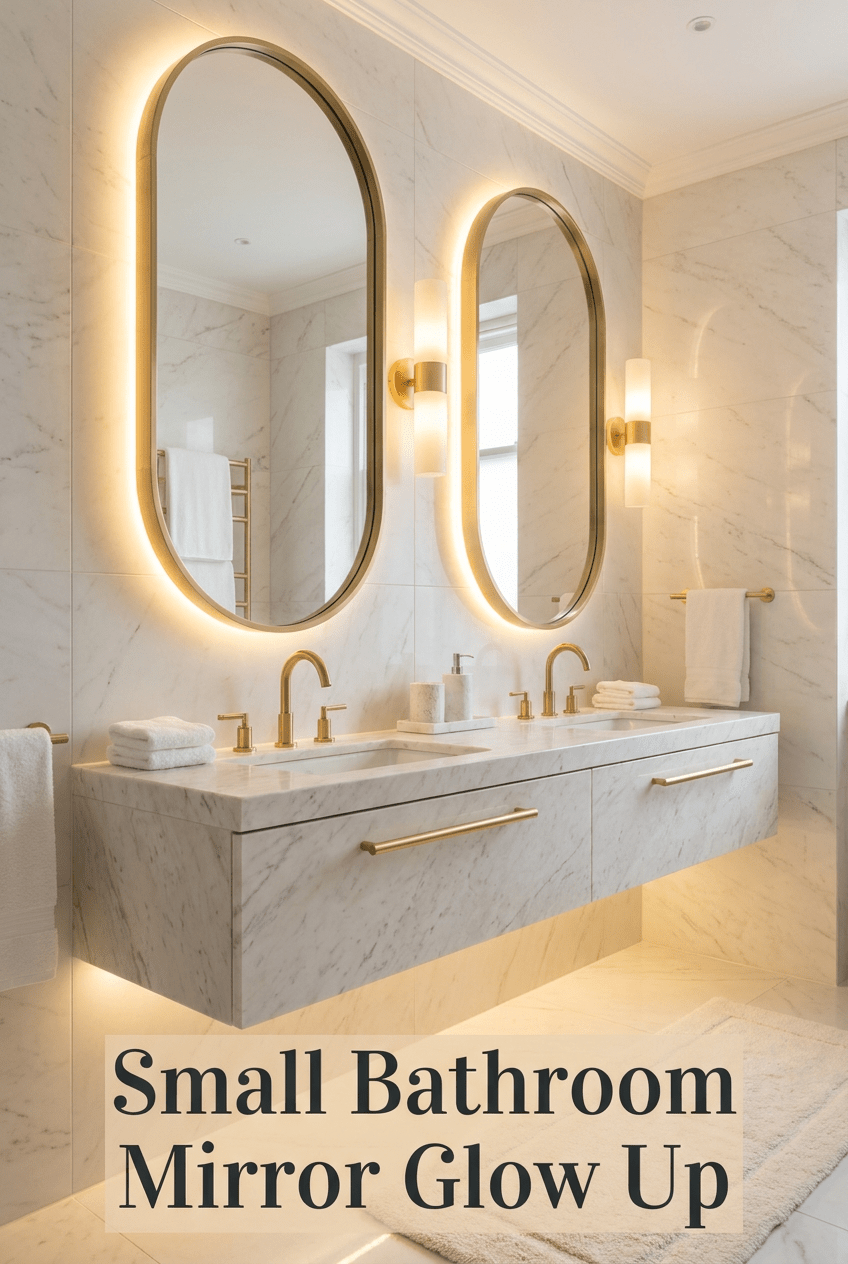
4. Two mirrors over a double vanity
Over a double vanity, two separate mirrors, like the oval brass-framed pair in this photo, give each sink its own space and leave room between them for a sconce. It looks more tailored than a single wide mirror.
Center each mirror on its faucet, and leave at least 4 to 6 inches between them for a light. Oval and pill-shaped mirrors work well in pairs because their curves balance a long, straight vanity.
The sconces and the glow under the floating vanity in this room add layers of light without a brighter ceiling fixture. Sconces at about eye level, 60 to 66 inches from the floor, light your face from the sides with fewer shadows than an overhead light.
If you have a single sink, one oval mirror with a sconce on each side gives the same look in a smaller space.
5. Frame the builder-grade mirror you already have
Many apartments have a plain mirror glued to the wall above the sink. Removing it can damage the drywall, but framing it in place makes it look custom.
Stick-on mirror frame kits cost about $40 to $120 and attach with adhesive strips. A DIY version uses lightweight trim or molding, cut to size, painted, and fixed to the mirror with mirror-safe adhesive. Leave a small gap where the mirror clips are, or notch the frame around them.
Paint the back of the trim black or dark gray first, so its reflection in the mirror edge doesn't show raw wood.
Measure the mirror carefully before buying a kit, and check how close the backsplash, faucet and side walls are, since the frame adds 2 to 4 inches all round.
6. Put a mirror where it reflects the window
A mirror placed opposite or beside a window reflects daylight across the room. In the first photo, the mirror catches the window beside the shower, which brightens the whole bathroom.
If the sink isn't opposite the window, consider a second, smaller mirror on the wall that is. Avoid hanging a mirror directly opposite the toilet, which most people find awkward.
7. An antique or tinted mirror
An antiqued, smoked or bronze-tinted mirror adds warmth and character in a bathroom with plain white tile. It reflects less light than clear glass, so it's best as a second, decorative mirror or in a bathroom with good light.
Vintage mirrors from thrift stores or flea markets often cost $15 to $50. Check the back for flaking silvering and the hanging wire for rust, since bathroom humidity speeds up both.
8. A mirrored medicine cabinet
In a bathroom without much storage, a mirrored cabinet adds shelves behind the glass for toiletries and medication. Surface-mounted cabinets screw onto the wall and cost about $60 to $250; recessed ones sit inside the wall and need cutting into the drywall.
Pick a cabinet the same width as, or slightly narrower than, the vanity. Mirrored doors on both the outside and the inside are handy for checking the back of your head.
Screw a surface-mounted cabinet into studs, since it gets heavy once it's full. In a rental, swap only with permission, and keep the original mirror to put back.
9. A shaped mirror as the focus
An arched, scalloped or irregular-shaped mirror turns a plain bathroom wall into something to look at. Arched mirrors also add height, since the curve draws the eye upward.
A shaped mirror still needs to be wide enough to use. Aim for a mirror at least as wide as the sink basin, and keep it in proportion to the vanity.
10. Add lighting around the existing mirror
If you can't replace the mirror, light it better. Battery or plug-in LED strip lights stuck to the back edge of a mirror create a backlit glow for $20 to $40. Plug-in sconces mounted on either side give face-level light without wiring.
Use strips with a waterproof rating, keep any plug and adapter well away from water, and plug them into a GFCI-protected outlet. Bathroom outlets in most homes are already GFCI-protected, often with test and reset buttons.
A warm 2700K to 3000K strip looks more flattering than a cool blue-white one.
11. Lean a large mirror against a wall
In a bathroom with a bit of floor space, a tall floor mirror leaned against a wall adds a full-length view and reflects the room without any drilling. It works well opposite the vanity or beside the door.
Secure the top of a leaning mirror to the wall with a strap or a small bracket, so it can't slide or tip if someone knocks it. Keep it away from the shower, where water and a wet floor make a fall more likely.
Keeping a bathroom mirror clear and fog-free
Steam fogs a mirror and, over time, can damage its backing. Run the exhaust fan during showers and for about 20 minutes after, and crack the door if the room has no fan. Our guide to stopping bathroom condensation covers fans, dehumidifiers and what to do when there's no window.
Clean mirrors with a microfiber cloth and a little glass cleaner sprayed on the cloth rather than the mirror, so liquid doesn't run down into the edges and cause black spots on the silver.
Common questions
What size mirror should go over a bathroom vanity?
Slightly narrower than the vanity, usually 2 to 4 inches less on each side, or the full width of the vanity wall for a bigger look. Hang it with the bottom edge 3 to 6 inches above the faucet or backsplash.
Can renters change a bathroom mirror?
Usually only with permission. Renter-safe upgrades include a stick-on frame kit, plug-in sconces, LED strips on the existing mirror and a leaning floor mirror.
Measure the wall and the vanity before you shop, and check where the outlets are if you want a lit mirror. For more small-bathroom ideas, see our guides to statement bathroom lighting under $80 and bathroom vanity upgrades.