
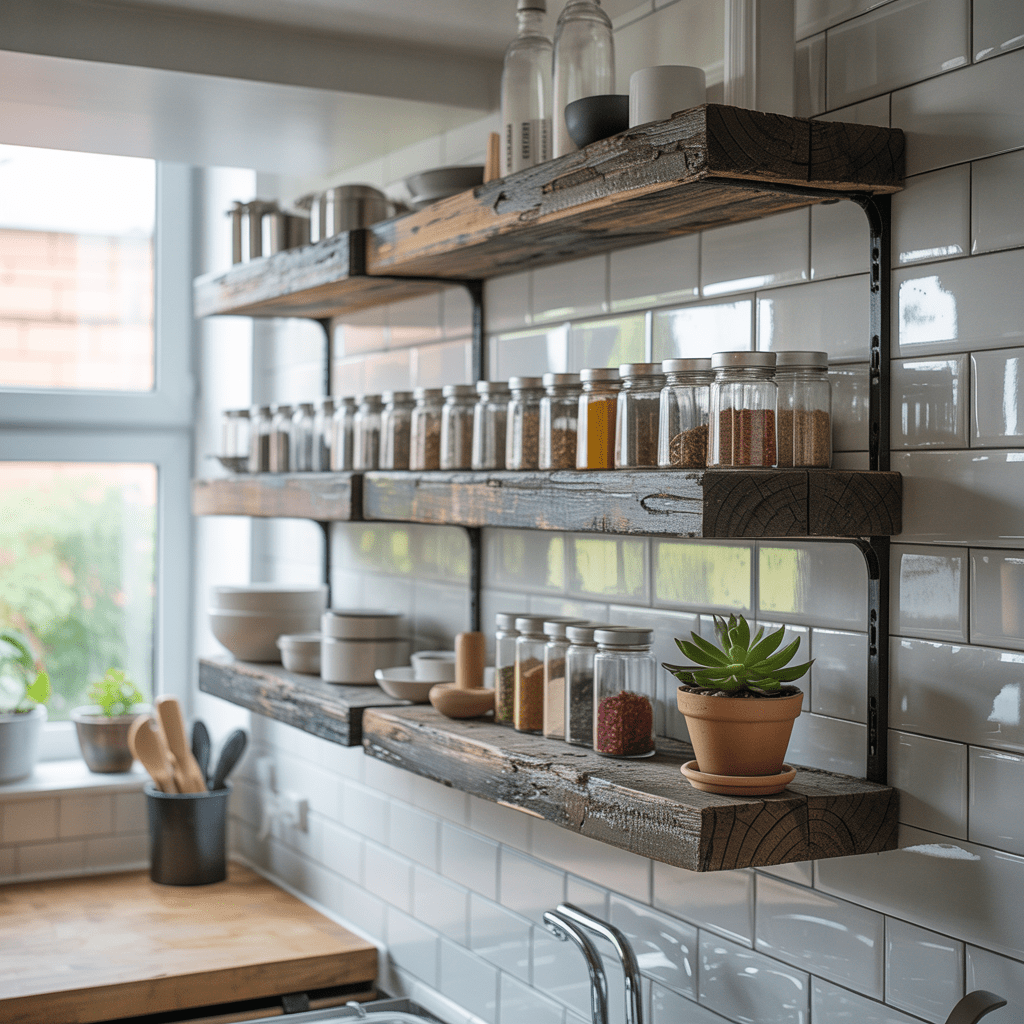
Wall shelves add storage without taking floor space, and in a small apartment that makes them one of the most useful things you can build. A store-bought set of solid wood floating shelves can cost $100 or more, but a stained pine board on a pair of brackets often costs under $30.
Not every shelf here is strictly floating. True floating shelves hide their brackets inside the board; others sit on visible brackets, which are cheaper and stronger, and easier to install. The four rooms in these photos use both. Whichever you choose, the most important step is the same: fixing it into studs or with anchors rated for the weight.
1. Stained pine on rail brackets
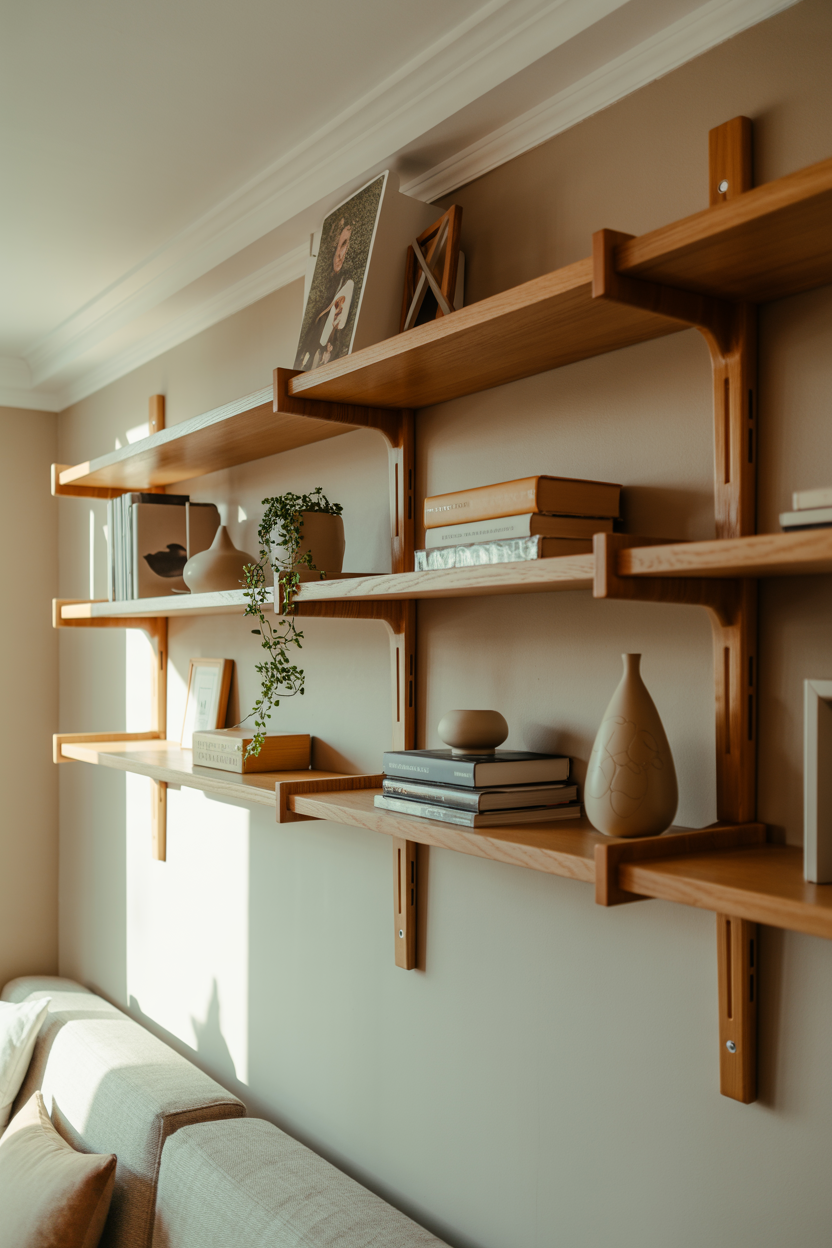
Pine boards stained a warm honey or walnut look far more expensive than they are. The shelves in this photo sit on wooden rail-and-bracket supports, so you can move them up and down as your needs change.
A 1-by-10 pine board, about 9.25 inches deep, costs $10 to $20 for a 4- to 6-foot length. Sand it smooth, apply a pre-stain conditioner so pine doesn't go blotchy, then stain and seal with a matte polyurethane.
Rail systems screw into studs at the uprights, so the shelves can hold books. Space the rails no more than about 32 inches apart, or every stud, to stop longer boards from sagging.
Style each shelf with a mix of books and one or two objects, and leave some space.

2. Dark-stained box shelves
Dark wood shelves, like the tall box shelving beside this bed, look rich and moody. A box shelf has sides and a back, so it frames whatever sits inside it.
Build simple boxes from 3/4-inch plywood, joined with wood glue and screws or a pocket-hole jig, then stain them a dark walnut or espresso. Edge-banding tape hides the plywood layers on the front.
Fix the boxes to the wall with screws through the back into studs. Tall stacked units also need an anti-tip strap at the top.
Candles and framed photos look warm on dark shelves, but use LED candles on wood near a bed.
Test the stain on an offcut first, since plywood takes stain more darkly than solid wood.
3. Kitchen planks on white brackets
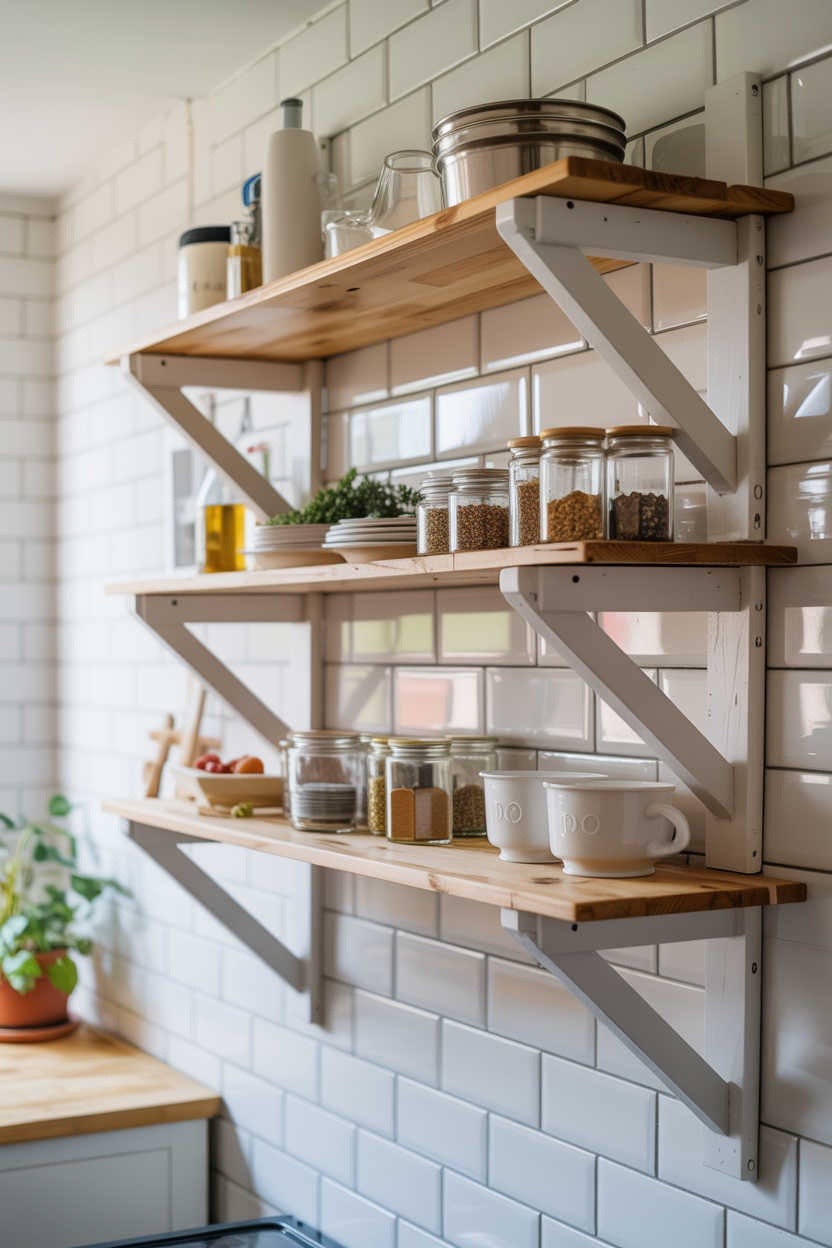
In a kitchen, light wood planks on simple white metal brackets, like the shelves on the subway tile in this photo, hold jars and mugs and look clean and bright.
Metal brackets cost a few dollars each and hold more weight than most hidden floating brackets. Seal the wood with a water-resistant finish, since kitchens are humid and shelves get splashed.
Drilling into tile needs a tile or masonry bit and slow speed; drill through grout lines where you can, and ask your landlord first in a rental. Keep shelves away from the stove, where heat and grease build up.
4. Box shelves above a desk
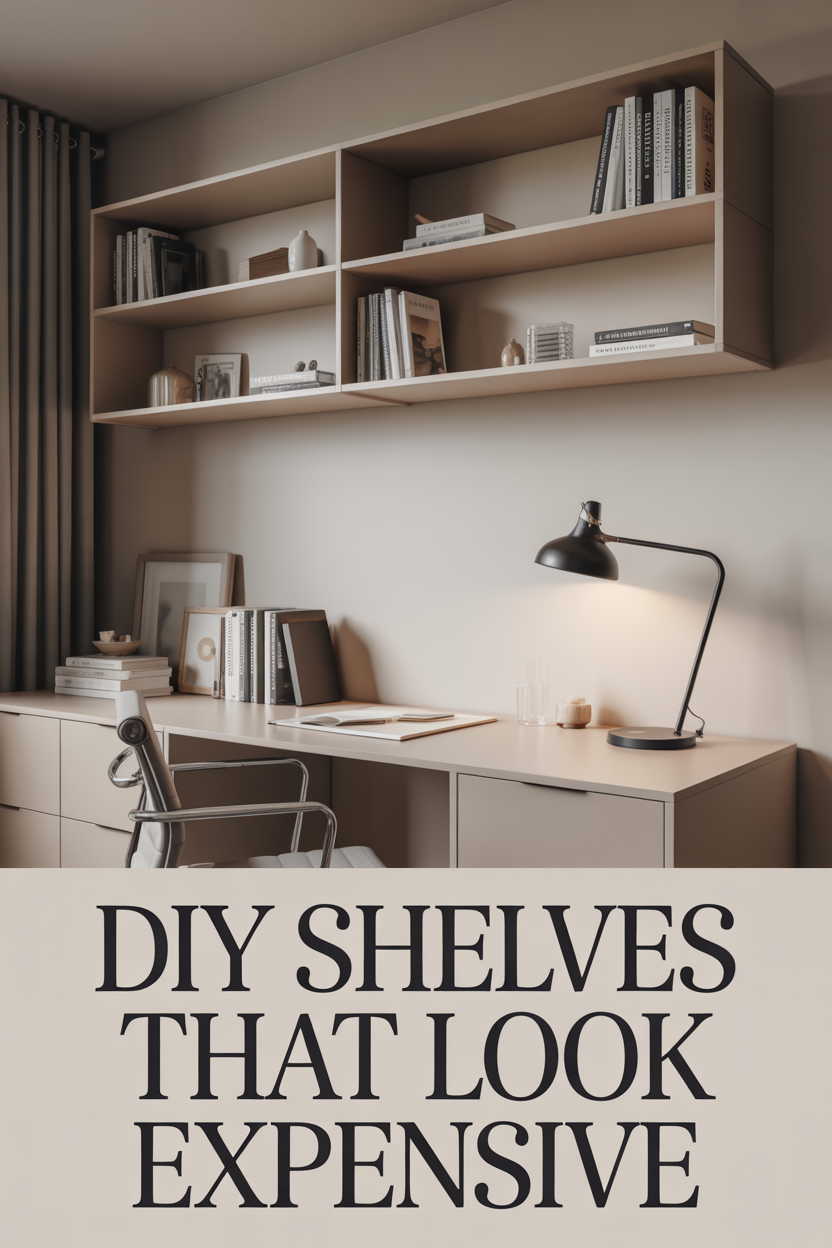
White wall-mounted box shelves, like the ones above this desk, hold books and supplies and keep the desk clear. Painted the same color as the wall, they almost disappear.
Hang the lowest shelf at least 18 inches above the desk so there's room for a lamp and a monitor. Shelves 8 to 10 inches deep hold most books.
Paint MDF or plywood boxes with a primer and two coats of satin or semi-gloss paint, which wipes clean.
Add a strip of LED light under the lowest shelf to light the desk without a lamp taking up space.
5. Hairpin or industrial brackets
Black metal hairpin or pipe brackets give a shelf an industrial look. They cost about $10 to $25 a pair and work well with rough or reclaimed wood.
Screw them into studs, and use a level. Pipe-style brackets are heavy and need strong fixings.
Reclaimed wood looks good on industrial brackets, but check it for nails and staples before cutting, and seal it so splinters and dust don't come off on books and hands.
Leave a few inches of board beyond each bracket at the ends; a board that stops exactly at the bracket looks unfinished.
6. Wooden crate shelves
Small wooden crates turned on their sides and screwed to the wall make cube shelves with a rustic look. Group three or four in a staggered pattern.
Sand them first, since crates can be rough, and screw each one into a stud or use strong anchors.
Crates look best in a loose grid with even gaps, about 2 to 3 inches between them. Lay them out on the floor first and photograph the arrangement, so you can copy it on the wall.
7. Bathroom shelves
A narrow shelf above the toilet or beside the sink holds towels and toiletries. Use wood sealed with a marine or exterior varnish, or a shelf made of leftover stone or tile on a wooden base, which stands up to humidity.
Keep shelves 24 inches or more above the toilet tank so you can still lift the lid.
Rounded front edges are safer in a small bathroom, where you can easily knock a hip or a head on a sharp shelf corner. Sand the corners or buy shelves with radiused edges.
8. Picture ledges
A picture ledge, a shallow shelf with a lip at the front, lets you lean art and photos instead of hanging each one. You can rearrange them without new holes.
Make one from a 1-by-4 board with a strip of 1-by-2 glued along the front edge as a lip. Mount it with screws into studs.
Ledges 3.5 to 4 inches deep hold most frames. Overlap a few frames of different sizes for a relaxed look, and put a bead of removable putty under each so they don't slide.
Mounting shelves safely
Use a stud finder and screw into wood studs wherever possible. Where there's no stud, use toggle or heavy-duty anchors rated for well over the weight the shelf will hold. A shelf of books weighs much more than it looks.
Hidden floating-shelf brackets usually hold less than visible brackets, often 15 to 50 pounds depending on the hardware, so check the rating. Use a level on every shelf, and in a rental, check your lease about holes; they fill easily with spackle when you move.
Building a true floating shelf
For a shelf with no visible brackets, buy a hidden floating-shelf bracket: a steel bar with rods that stick out from the wall. Screw the bar into at least two studs, then drill matching holes into the back edge of a thick board, at least 1.5 inches, and slide it on.
Measure and mark the rod positions carefully, and drill straight with a drill guide or a scrap block as a jig; crooked holes make the shelf tilt. A dab of construction adhesive in each hole stops the board from sliding off.
Glue two 3/4-inch boards together if you can't find thick lumber, or build a hollow box around a wood cleat. A hollow box looks chunky but weighs much less, which helps on drywall.
Common questions
How much weight can a DIY floating shelf hold?
It depends on the bracket and the wall. Shelves screwed into studs with visible brackets can hold a shelf of books; hidden floating brackets often hold 15 to 50 pounds. Check the bracket rating.
What wood is best for DIY shelves?
Pine is cheap and easy to stain; plywood is strong and stable for box shelves. Use a pre-stain conditioner on pine to avoid blotches.
Start with one shelf, mount it into studs, and add more once you see how it looks. For more ideas, see our guides to DIY built-in bookshelves and kitchen open shelving.