
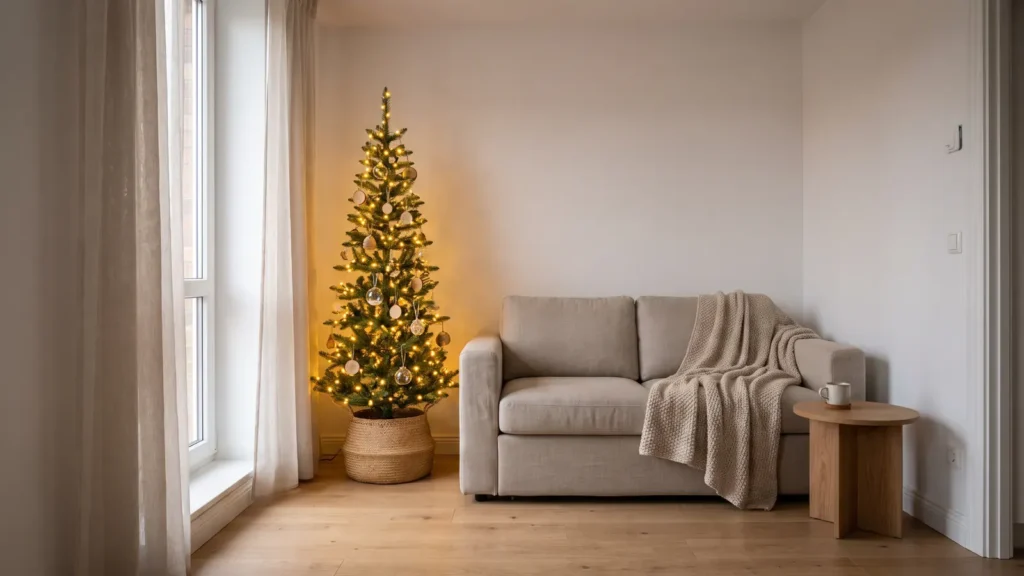
Buying a Christmas tree for a small apartment is easy to get wrong. A tree that looked modest in a store with 20-foot ceilings can swallow half your living room, scrape your ceiling or block the only path between the sofa and the kitchen. And once it’s in the stand and decorated, nobody wants to haul it back out.
The fix is to do the planning before you shop: measure the space you actually have, choose a shape that suits it, decide between real and artificial with your lease and storage in mind, and pick a safe spot before the tree comes through the door. This guide walks through each step, with sizes, rough costs and the mistakes that most often turn a festive corner into an obstacle.
1. Measure the space before you shop
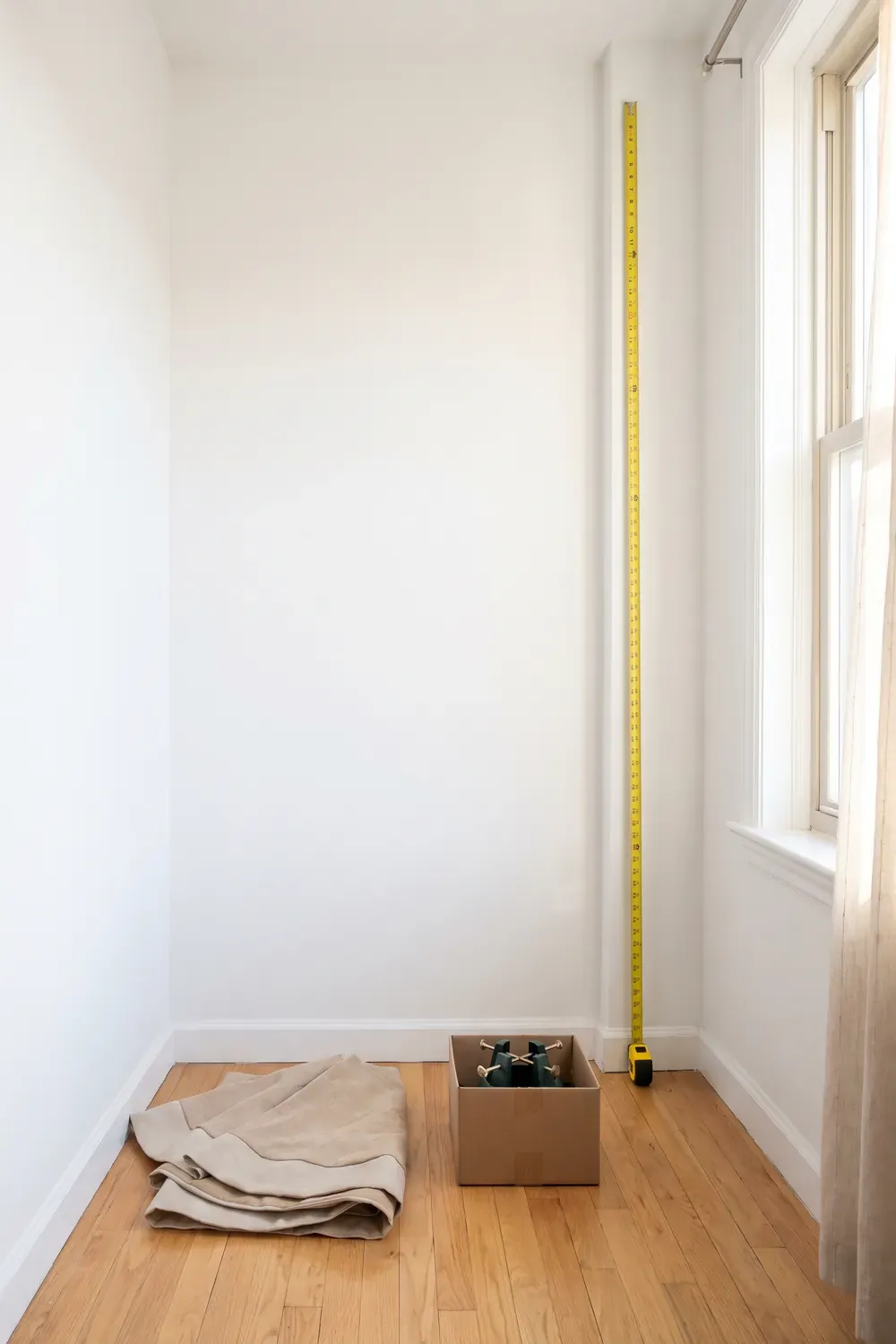
Start with the ceiling. Measure from the floor to the ceiling in the exact spot where the tree will stand, not in the middle of the room, because older apartments often have soffits, beams or sloped sections. Then subtract 6 to 12 inches: the stand adds a few inches at the bottom and a star or topper needs room at the top. With a standard 8-foot ceiling, a 6.5- to 7-foot tree is the most you want. A 7.5-foot tree will almost always feel jammed against the ceiling.
Next, measure the floor. Note how wide the spot is between walls, furniture and windows, and how far it can project into the room without narrowing a walkway to less than about 30 to 36 inches. Tree listings give the diameter at the widest point, usually the bottom branches, so compare that number to your floor measurement rather than eyeballing it. Write both numbers in your phone before you go shopping, along with the height of any window sill or shelf the tree has to clear.
- Ceiling height at the tree spot, minus 6–12 inches for stand and topper
- Floor width and depth available, compared to the tree’s listed diameter
- Walkway left in front: aim for at least 30–36 inches
Tip: Mark the tree’s diameter on the floor with painter’s tape for a day. If you keep stepping on the tape, the tree is too wide for that spot.
2. Know the shapes: full, slim, pencil, half and tabletop
Tree height gets most of the attention, but in a small apartment the width is the bigger problem. A traditional full tree at 6.5 feet is often 50 to 60 inches across at the base, which is wider than many studio corners. A slim tree of the same height is usually around 30 to 40 inches wide, and a pencil tree can be as narrow as 20 to 28 inches. That difference is the space for a chair, a side table or simply a clear path.
There are also shapes built for awkward spots. Half trees, sometimes sold as flat-back or wall trees, are fully branched on the front and flat on the back, so they sit tight against a wall and project only half as far into the room. Tabletop trees, typically 2 to 4 feet tall, go on a console, dresser or wide bookshelf and use no floor space at all. Each shape suits a different apartment: pencil trees for narrow corners, slim trees for a standard corner, half trees for a flat wall and tabletop trees when the floor is already spoken for.
For a rough budget, slim and pencil artificial trees around 6.5 feet often run about $80 to $250 depending on how realistic the branches are and whether lights are built in. Tabletop trees are commonly $20 to $60. Half trees sit somewhere in between.
- Full: classic look, but often 50–60 inches wide at 6.5 feet
- Slim: about 30–40 inches wide, the best all-round fit for a living room corner
- Pencil: 20–28 inches wide, for narrow corners and beside doors
- Half or flat-back: sits flush to a wall, ideal for studios
- Tabletop: 2–4 feet, no floor space needed
3. Real or artificial in a small apartment?
A real tree smells wonderful and needs no storage space for the other eleven months, which is a real advantage in a small apartment. On the other hand, it sheds needles, needs watering every day and has to be carried in and out through shared hallways. Check your lease or building rules before you buy one: some buildings ban real trees, especially in high-rises, and others require them to be removed by a set date in January.
An artificial tree costs more up front but can last many seasons, doesn’t drop needles into your rug and can be put up as early as you like. The catch is storage. Even a slim tree in its box can take up as much space as a small suitcase, so decide where it will live before you buy, not on December 26. Pre-lit models save time and tangle, but if one section of lights fails later it can be fiddly to fix.
If you go real, the U.S. Fire Administration and the National Fire Protection Association both stress the same habits: choose a fresh tree with green needles that don’t fall off when touched, cut a little off the base before it goes in the stand, and add water every day so the base never dries out. A dry tree catches fire far faster than a watered one. If you go artificial, look for a tree labeled as fire resistant.
4. Find the spot before the tree arrives
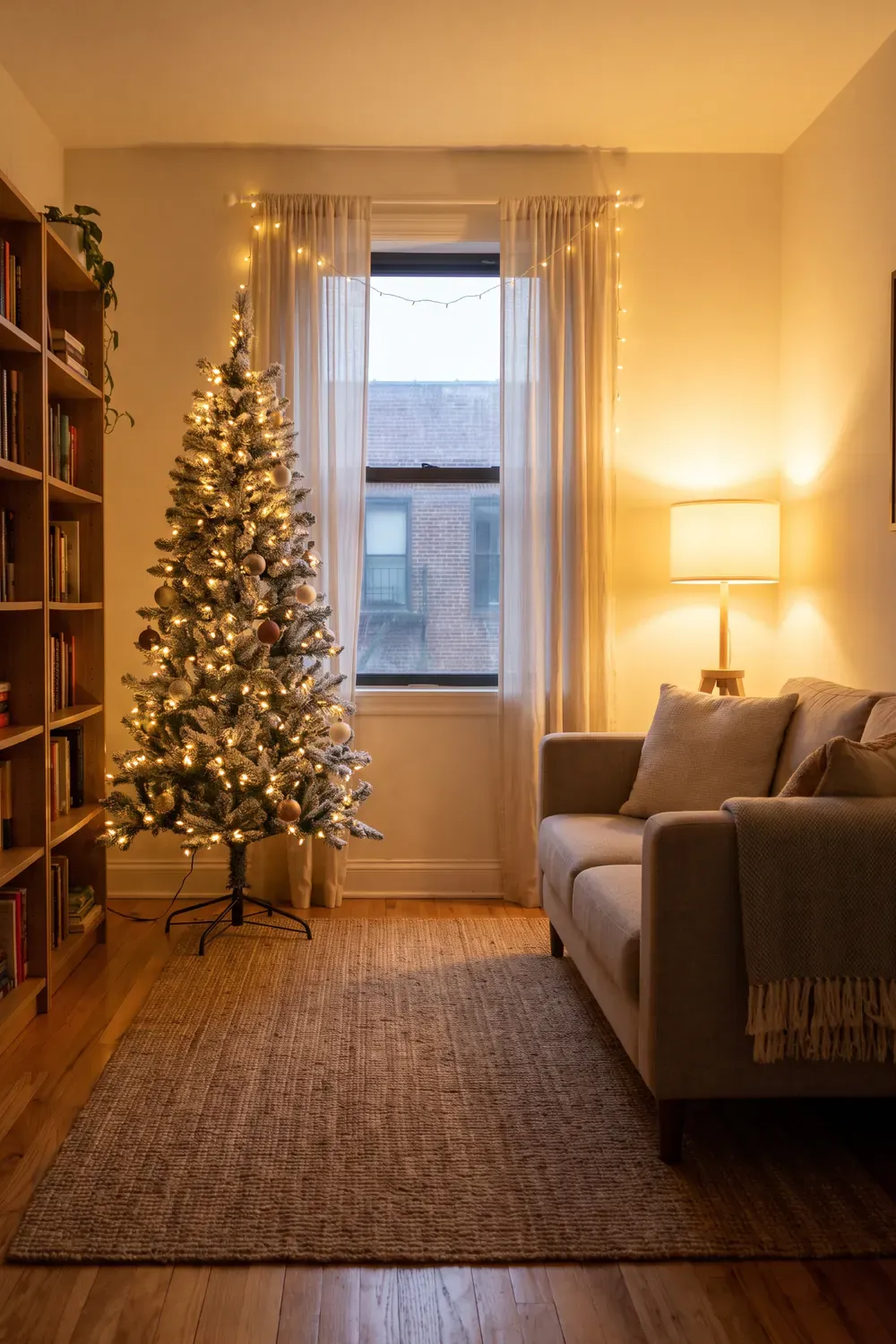
In most small apartments the best spot is a corner, because a tree there uses space that is usually empty anyway. A corner beside a window is a favorite: the lights are visible from outside and the room still feels open. Avoid placing the tree in front of the only window, though, since it blocks daylight at exactly the time of year you need it most.
Keep the tree well away from heat. Fire safety guidance says at least 3 feet from radiators, baseboard heaters, space heaters, fireplaces and candles, and heat also dries out a real tree quickly. In a studio, that rule often decides the spot for you. Also keep the tree clear of the front door and the main walkway so nobody brushes past it with a laundry basket or a coat.
If the only free corner is behind the sofa or next to the TV, you can shuffle the room for the season. Rotating a sofa 90 degrees, moving an armchair into the bedroom or swapping a side table for a stool often frees a tree-sized corner. For more ideas on arranging furniture in a single room, see these living room layouts for studio apartments.
- Corner beside a window: visible from outside, keeps the room open
- At least 3 feet from radiators, heaters and candles
- Not blocking the front door, a walkway or the only window
- Close enough to an outlet that you don’t need an extension cord across the floor
5. Tabletop and wall trees when floor space is zero
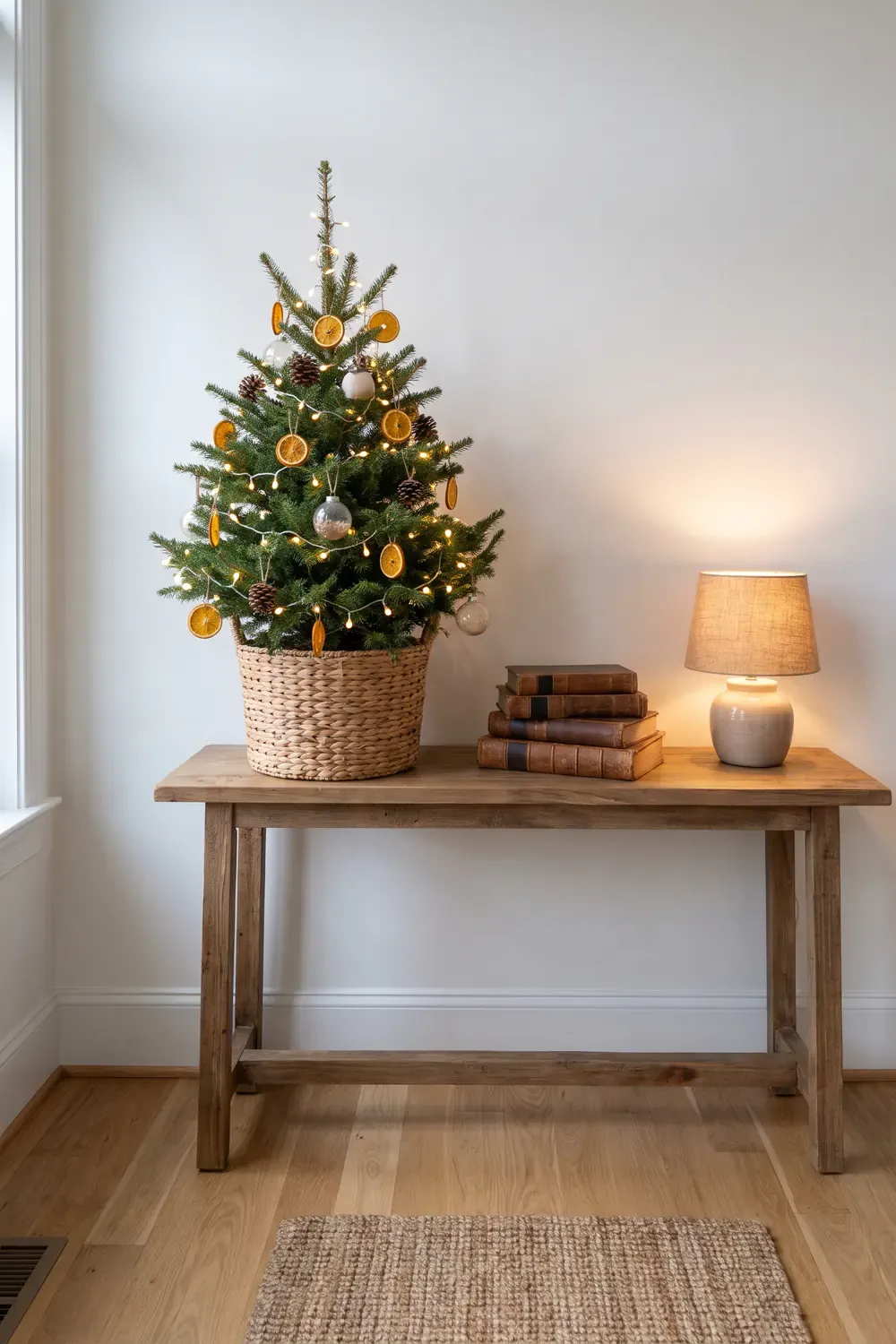
If every corner already holds furniture, put the tree on furniture. A 3-foot tabletop tree on a console table, dresser or sturdy bookshelf can carry the whole holiday look, especially when it sits in a woven basket or a ceramic planter instead of a plastic stand. Raised up to eye level, a small tree looks more substantial than it would on the floor.
For an even flatter option, try a wall tree. Some are made from wooden dowels or branches hung from a single hook, others are just a string of lights arranged in a triangle with a few ornaments clipped on. Use removable adhesive hooks rated for the weight so the wall is undamaged when you take it down, and test one hook on an inconspicuous spot first, since some paints peel. You can also lean a slim ladder against the wall and drape it with garland and lights.
Small trees are also a good way to add a second festive spot. A tiny tree on a kitchen counter or a bedroom dresser makes the whole apartment feel ready for the holidays without one big tree dominating the main room. You’ll find more space-saving ideas in our guide to holiday apartment decor that doesn’t feel cramped.
Tip: Plug a tabletop tree’s lights into a simple plug-in timer so they switch on at dusk and off at bedtime. No reaching behind furniture every evening.
6. Stands, bases and protecting rental floors
The stand is more important in a small space, because a tree that leans or wobbles is more likely to be knocked over in a tight room. For a real tree, choose a stand sized for the trunk diameter and one that holds plenty of water, ideally a gallon or more, and make sure the tree is straight and secure before you decorate. For an artificial tree, use the stand it came with and spread the legs fully.
Protect the floor under it. Put a waterproof tray or a boot tray under a real tree’s stand so spills and overflow don’t reach a wood floor or carpet, and add felt pads under the stand legs to prevent scratches. Damage to rental floors is one of the most common deposit deductions, and a slow drip from a tree stand can warp floorboards over a few weeks without anyone noticing.
To hide the stand, a tree collar or a large basket ($20–40) looks neater than a fabric skirt in a small room, because a skirt spreads wide and pushes the tree past the spot you measured.
- Real tree: a stand sized to the trunk that holds a gallon or more
- Waterproof tray under the stand, felt pads under the legs
- A tree collar or basket instead of a wide skirt to save floor space
7. Lights: fewer strands, warm white, safe cords
LED lights are the obvious choice for an apartment. They run cool, use far less electricity than old incandescent strands and are less of a fire risk. A common rule of thumb is roughly 100 lights for every foot of tree height for a full look, but slim trees need fewer because there are fewer branches to cover. Start with a little less than you think and add a strand if it looks thin.
Warm white light makes a small room feel cozy, while cool white or multicolor can feel busy up close. Use lights labeled for indoor use by a recognized testing laboratory, check every strand for broken bulbs or frayed wires, and follow the limit on how many strands can be connected end to end.
Cords are the bigger issue in a small apartment. Avoid running an extension cord across a walkway or under a rug, where it can be tripped over or damaged. Place the tree near an outlet instead, and turn the lights off when you go to bed or leave home. A plug-in timer or a smart plug makes that automatic.
Tip: Wrap lights from the trunk outward along each main branch instead of circling the outside. The tree glows from inside and you use fewer lights.
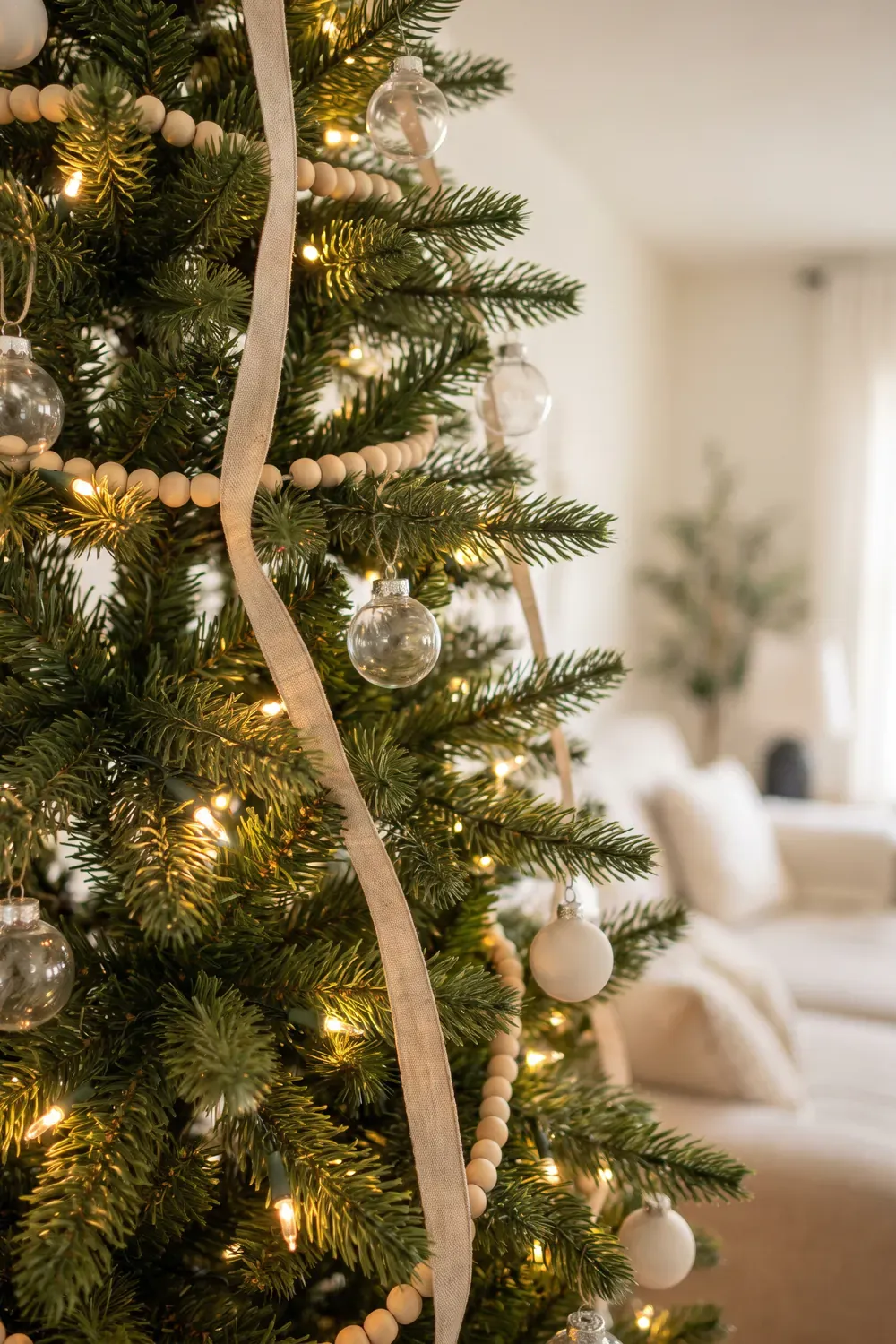
8. Decorate a slim tree so it looks full
Slim trees look best with smaller ornaments. Large baubles that suit a full tree can make a narrow one look overloaded and top-heavy. Ornaments around 1.5 to 2.5 inches across are a good scale for slim and pencil trees, with a few larger pieces kept near the bottom where the branches are widest.
Keep the palette tight. Two or three colors, or a simple mix of clear glass, white and natural wood, looks calmer in a small room than a tree covered in every ornament you own. This also fits the current trend toward natural materials such as wood beads, dried orange slices and simple ribbons. Hang some ornaments deep inside the tree rather than only on the tips, which adds depth and makes a slim tree look fuller.
Run ribbon or garland vertically from top to bottom instead of wrapping it around in horizontal bands. Vertical lines make the tree look taller and slimmer, which suits a small apartment, and they’re quicker to put up and take down. Finish with a lightweight topper so the top of a slim tree doesn’t bend under its weight.
- Ornaments about 1.5–2.5 inches for slim and pencil trees
- Two or three colors, or glass, white and wood
- Some ornaments tucked deep into the branches for depth
- Ribbon running vertically, and a lightweight topper
9. Plan where it goes after the holidays
If you choose an artificial tree, plan the storage now. Most cardboard boxes split within a season or two, so many people switch to a zippered storage bag, which compresses a little and has handles. Slim trees often fit standing upright in the back of a closet or flat under a bed with enough clearance. If you are short on space, a storage ottoman can hold lights and ornaments, so only the tree itself needs a spot.
For a real tree, find out how your city or building handles disposal before you buy. Many cities run curbside tree collection or drop-off sites in early January, and many buildings ask you to wrap the tree in a tree bag or an old sheet before carrying it through the halls to avoid a trail of needles. Take the decorations off and remove the tree promptly once it starts to dry out, since a dry tree is the biggest fire risk of the whole season.
Tip: Before you buy an artificial tree, check its packed size in the listing and measure the closet or under-bed space where it will live. If it doesn’t fit there, pick a smaller tree.
Common questions
What size Christmas tree fits an 8-foot ceiling?
A 6.5- to 7-foot tree. Leave 6 to 12 inches for the stand and topper, so the top doesn’t touch or bend against the ceiling.
How wide is a slim Christmas tree?
Usually about 30 to 40 inches at the base for a 6.5-foot tree, compared with 50 to 60 inches for a full tree. Pencil trees can be 20 to 28 inches wide.
Can you have a real Christmas tree in an apartment?
Often yes, but check your lease first, because some buildings ban them. Keep it at least 3 feet from heat sources and water it every day.
Where should a Christmas tree go in a studio apartment?
In a corner away from heaters and the main walkway, ideally beside a window rather than in front of it. If no corner is free, a half tree against a wall or a tabletop tree on furniture works well.
The right Christmas tree for a small apartment is the one chosen with a tape measure as well as your heart. Measure the height and floor space, pick a shape that suits your spot, decide between real and artificial with your lease and storage in mind, and keep the tree away from heat and walkways. Then decorate it lightly so it looks full without crowding the room.
Once the tree is sorted, the rest of the season is easier. Pair it with a few winter apartment decor ideas, and if you’re hosting, read our guide to guest bed ideas for small apartments before family arrives.