
A closet office, sometimes called a cloffice, turns an underused closet into a workspace you can close when you finish work. In a small apartment, that's often the only way to have a desk that isn't the dining table or the sofa.
Most reach-in closets are 24 to 30 inches deep and 4 to 8 feet wide, which is enough for a desk with shelves above it. The four closets in these photos show what's possible. Before you start, check three things: whether there's an outlet inside or nearby, how you'll light it, and whether the closet gets warm with the door shut. And in a rental, ask before removing doors or drilling.

1. A floating desk
A wall-mounted desk, like the wood one in this narrow closet, leaves the floor clear so the chair slides all the way in. It also fits the closet exactly, which freestanding desks rarely do.
Cut a countertop or a thick board to the closet's width and rest it on wall cleats screwed into the studs at the back and sides. A depth of 20 to 24 inches suits a laptop and a monitor, and a height of 28 to 30 inches suits most chairs.
The shelves above hold books and a few objects, and an LED strip under the lowest shelf lights the desk.
Check the closet's width before choosing a chair. A chair with no arms, like this one, slides under the desk and lets you close the door.

2. A dark painted interior
Painting the inside of the closet a deep color, like the navy in this photo, makes the office feel like a separate room. With a velvet chair and brass lamps, it looks deliberate and polished.
A quart of paint is usually enough for a closet interior. Choose an eggshell or satin finish, which wipes clean. In a rental, ask first and note the original color so you can repaint before moving out.
Dark colors need good light. Add a desk lamp and an LED strip so you're not working in a cave.
Paint the shelves and the desk the same color as the walls for a built-in look, or keep them natural wood for contrast, as with the brass details here.

3. A pegboard and a slim desk
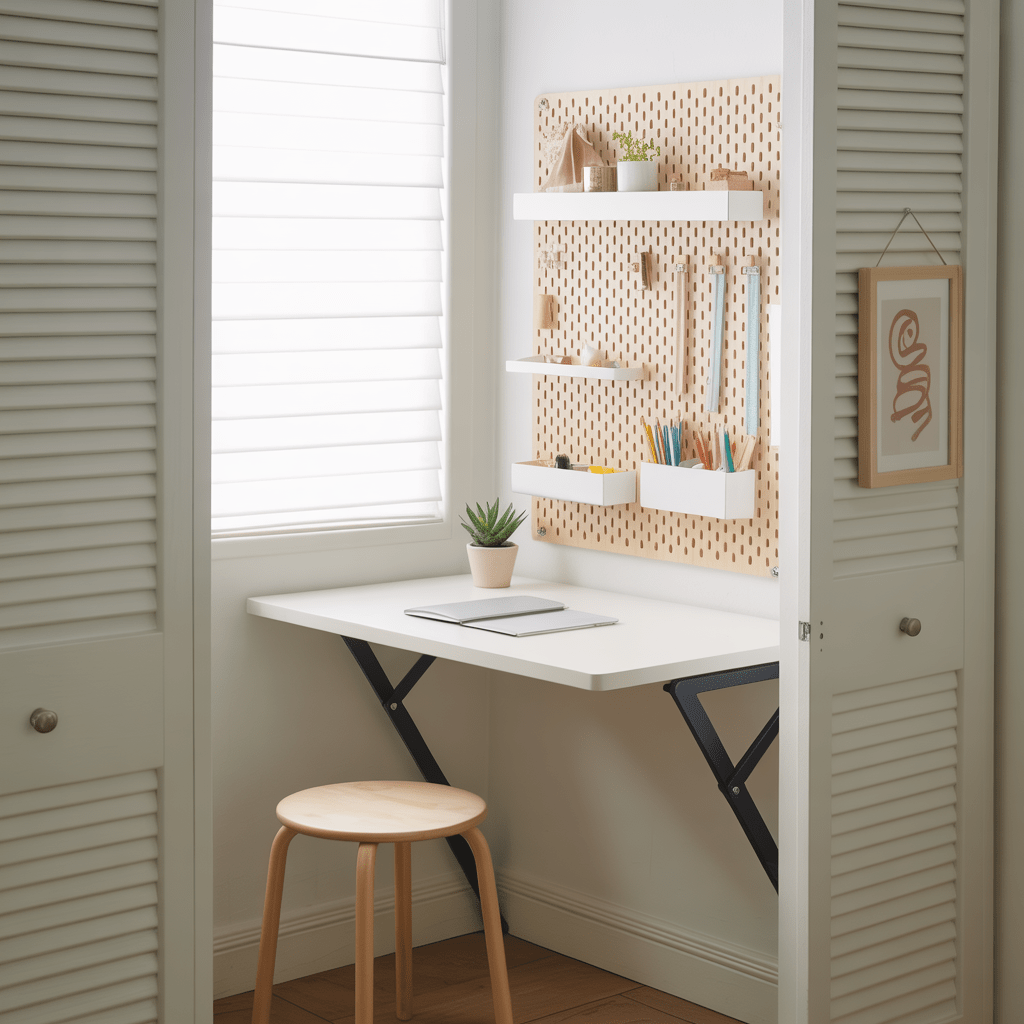
A wood pegboard on the back wall, like the one in this bright white closet, holds supplies and notes without cluttering the desk. Small shelves and hooks on it hold pens, cables and a few photos.
Mount the pegboard on spacers so the hooks fit behind it, and screw it into studs. A slim desk, or a fold-down desk that closes against the wall, leaves room for a stool to tuck underneath.
If the closet has a window, as this one does, put the desk beside it rather than facing it, so you don't get glare on the screen.

4. Warm wood shelves and soft light
Wood shelves and a warm lamp make a closet office feel cozy rather than cramped. The corner desk in this photo sits under L-shaped shelves, with a lamp on the desk and wood bifold doors that close it away.
Corner desks use a wider closet well. Support both sides of the desk and the shelves on cleats screwed into studs, and keep the heaviest books on the lowest shelves.
Use a lamp with a warm bulb around 3000K for evenings, and a brighter task light for working.
Measure the closet door opening as well as the inside. Many closets are wider inside than the door, so a desk cut to the full width may need to go in at an angle or in two pieces.
5. A monitor arm
A monitor arm clamps to the back of the desk and lifts the screen to eye level, freeing up desk space underneath. In a shallow closet, it also lets you push the screen back toward the wall.
Arms cost about $30 to $100. Check that the desk is thick enough for the clamp, and that the arm suits your monitor's weight.
Set the top of the screen at or just below eye level, about an arm's length away. In a closet only 24 inches deep, a laptop on a stand with a separate keyboard can work better than a full monitor.
6. Curtains instead of doors
Bifold or sliding closet doors can get in the way of a chair. Replacing them with a curtain on a tension rod or a ceiling track hides the office and takes up no space when open.
In a rental, store the original doors and their hardware, labeled, and put them back when you leave.
Choose a curtain in a color that matches the room outside rather than the closet inside, so it blends in when closed. A heavier, lined curtain hides the desk completely when guests are over.
7. Shelves up to the ceiling
Closets often have space above the door frame and at the top that goes unused. Shelves all the way up hold files and supplies you need less often.
Keep a small step stool nearby, and put the things you use daily at eye level.
Lidded boxes in one color on the top shelves look tidier than open stacks of files, and labels on the front save you climbing up to check what's inside.
8. Power
Most closets have no outlet. A surge-protected power strip with USB ports, mounted under the desk, handles a laptop and monitor plus a lamp.
Run its cord to the nearest outlet along the baseboard with a cord cover, not under a rug or through a door that closes on it. Don't chain power strips together. If you need a new outlet inside the closet, that's a job for an electrician and the landlord.
Stick a cable tray or a few adhesive cable clips under the desk to hold the power strip and the extra cord length off the floor, where a chair can roll over it.
9. A personal back wall
The wall in front of the desk is what you look at all day. A print or two, or a strip of peel-and-stick wallpaper, makes it yours.
Keep it calm if you take video calls. Our guide to home office wall decor covers what looks good on camera.
A slim cork strip or a small magnetic board at eye level holds a to-do list and a calendar without covering the wall. Clear it out every month so it stays useful.
10. A small mirror
A small mirror on a side wall reflects light into the closet and makes it feel less enclosed. It's also handy for a quick check before a video call.
Use a lightweight mirror, and hang it with hardware rated for its weight.
Hang it to the side of the desk, not directly in front, so you don't see yourself all day while you work.
Keep the closet cool
A closed closet with a laptop and a lamp can get warm. Leave the door or curtain open while you work, use LED bulbs, which run cool, and add a small desk fan in summer.
Don't close the closet with a laptop charging on a soft surface, and switch off the power strip when you finish work. Our guide to home office lighting covers lights that stay cool.
Common questions
How deep does a closet need to be for an office?
About 24 inches is enough for a laptop desk. For a monitor and keyboard, 24 to 30 inches works best, or use a monitor arm to push the screen back.
Can you make a closet office in a rental?
Usually, yes. A freestanding desk or one on removable cleats, a curtain instead of doors and a plug-in power strip are all reversible. Ask before painting or drilling.
Measure the closet, plan power and light first, and then build the desk. For more office ideas, see our guide to minimalist home offices.