
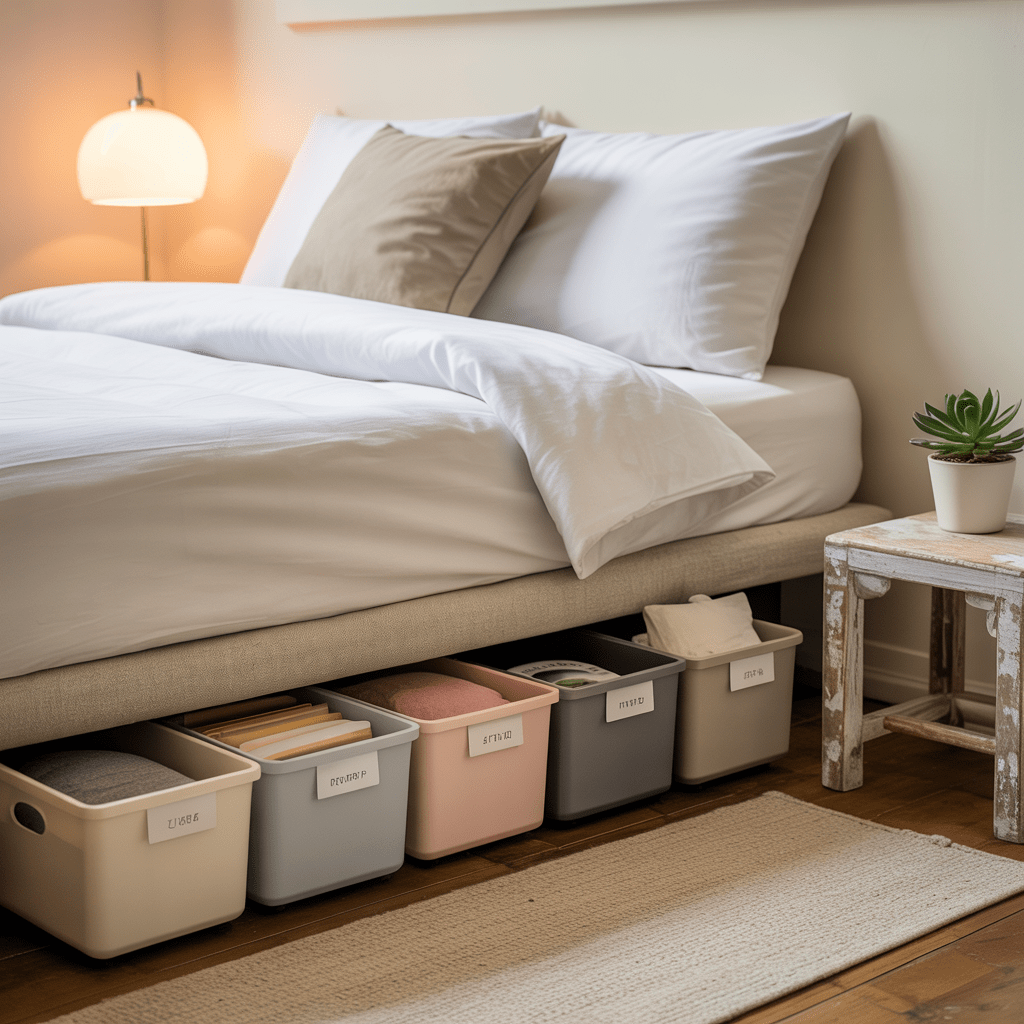
Under the bed is the biggest storage space most small apartments have, and it usually ends up holding one suitcase and a lot of dust. A queen bed covers roughly 33 square feet of floor. Even with only 6 inches of clearance, that's enough room for a whole season of clothes plus the shoes you aren't wearing this month.
What makes under-bed storage work is fit. Containers that are half an inch too tall won't slide in, and ones you can't reach easily end up never being opened. Start with a tape measure, then pick from the ideas below based on what you're storing and how often you need it.
1. Measure the gap before you buy anything
Measure from the floor to the underside of the bed frame or slats, at the side where you'll pull things out. Many metal frames leave about 7 inches, platform beds often 4 to 6, and some low upholstered beds less than 3. If there's a center support bar or legs in the middle, note where they are, because they decide how long a bin can be.
Then subtract half an inch to an inch, so bins slide in without scraping, and look at the depth too. Most under-bed boxes are 30 to 40 inches long, which suits the side of a full or queen bed. Measure the floor in front as well: drawers and wide bins need 18 to 24 inches of clear space to pull out, and a nightstand in the way is the most common reason people stop using under-bed storage.
- Height: floor to the bottom of the frame, minus about 1 inch
- Length and position of any center legs or support bars
- Clear floor space beside the bed for pulling bins out

2. A bed with drawers built in
If you're buying a bed anyway, a frame with drawers in the base is the tidiest option there is. Nothing sits loose on the floor, and the drawers can replace a small dresser. IKEA's Malm and Brimnes frames are well-known examples, and most furniture retailers now sell storage beds in wood, upholstered and metal versions.
There are two types. Drawer beds slide out from the sides, so they need that clear floor space beside the bed. Lift-up beds raise the whole mattress platform on gas struts and hold far more, which suits bulky things like duvets and suitcases, but you have to strip back the bedding to reach in. In a bedroom where the bed is pushed against a wall, a lift-up frame or drawers on one side only is often the better fit.
Wicker baskets or fabric bins inside the drawers, as in the photo, stop folded linens from sliding around and let you lift out one category at a time.

3. Lidded fabric boxes for things you use every month
Structured fabric boxes with lids are a good middle ground between plastic bins and baskets. They look like furniture accessories rather than garage storage, the lids keep dust off, and most have a handle or a cut-out on the short end so you can pull them out with one hand. A pair usually costs $20 to $35.
Use them for things you reach for every few weeks, like spare sheets or gift wrap. Choose boxes with a firm base, because soft-bottomed ones sag when they're full and catch on carpet. Two or three identical boxes in one neutral color look calm from across the room, even when they're not hidden.
Tip: Stick a label or a small photo of the contents on the end that faces out, so you don't have to pull every box to find one thing.

4. Rolling bins for anything you reach for often
Wheels change how often you use under-bed storage. A heavy bin you have to drag across a rug gets opened twice a year, while one that rolls out with a light pull becomes part of the routine. Rolling under-bed bins and drawers typically run $20 to $40 each, and some beds and platforms come with a rolling base built in, as in the photo.
Check the height including the wheels, since casters add half an inch to an inch and a half. Hard floors work best; on thick carpet, bigger wheels or a rolling tray with a smooth base glide more easily. Rolling bins suit everyday items like shoes, gym clothes or a laundry overflow bin, while things you only touch twice a year can go in cheaper boxes further back.
You can also make a rolling bin from a wooden crate and four small casters. Check the height first: standard craft-store crates are 9 to 10 inches tall before the wheels go on, which is too tall for most beds, so look for shallow crates or fix casters to a flat board with a lip around the edge instead. Line wooden versions with fabric so the slats don't snag clothes.

5. Lined baskets for linens and blankets
Woven baskets bring some warmth into a bedroom where the storage shows, especially under a raised metal frame like the one in the photo. Pick baskets with a fabric liner. Bare weave snags sweaters and lets dust through, and a liner that ties or zips closed works almost as well as a lid.
Baskets suit soft, light things such as a spare duvet cover or a couple of throws. They're less good for heavy or small items, which get lost in the bottom or pull the weave out of shape. Expect $25 to $50 for a good-sized basket, and check the height carefully, since handles often stick up an inch or two above the rim.
6. Vacuum bags for bulky seasonal things, with limits
Vacuum storage bags shrink puffy items like comforters and ski jackets down to a flat package you can slide under even a low bed. They're the most compact way to store a synthetic spare duvet, and a set of several bags costs $15 to $30.
They aren't right for everything. Down and feather duvets and jackets can lose some of their loft if they stay compressed for months, so a breathable cotton storage bag is kinder to them. Wool and leather also need air. Keep vacuum bags for synthetic fills, fleece and off-season clothes, and put the flat bags inside a box or bin so they don't slide around or get punctured.
Always label bags before you seal them. Once they're compressed, a bag of winter sweaters and a bag of spare blankets look exactly the same.
7. Clear shoe boxes, one pair each
Shoes are often what fills a small closet floor, and they suit under-bed storage well because a row of shoe boxes fits a low gap. Clear plastic boxes with drop-front lids let you see each pair and stack two high under a taller bed. In multipacks they usually cost $2 to $5 each.
Measure your shoes before you buy. Standard boxes fit most flats and sneakers, while larger sizes and high-tops need the bigger version, and boots rarely fit under a bed at all. Store only the shoes you're not wearing this season. The pairs you use every week belong by the door.
8. Bed risers when the gap is too small
If your bed sits too low for anything useful, bed risers lift it by 3 to 8 inches and turn a 4-inch gap into room for proper bins. A set of four usually costs $15 to $30. Choose risers with a cup or recess that fits your bed's legs, and stick with ones rated well above the weight of the bed and the people in it.
Risers work best on beds with simple straight legs. They're not a good idea for frames with wheels, very thin legs or a center leg that can't be raised too, because the bed can slip off. A higher bed also changes how it feels to sit on and get into, so consider how high is comfortable before you choose the tallest set.
9. Know what doesn't belong under the bed
Some things are better kept elsewhere. Important papers and anything you'd grab in an emergency, like a passport or a go-bag, should live somewhere you can reach in seconds. Food, even sealed snacks, attracts pests to a spot you rarely clean. Anything that needs air, such as leather bags or a wool coat, does badly in a sealed bin pushed against the wall.
Ground-floor and basement apartments need one more check. If the floor ever feels cold or damp, or the room smells musty, keep containers off the floor on a low rolling base or a slatted board, and choose plastic over cardboard or fabric. Moisture under a bed goes unnoticed for months, and by the time you open the bin, the contents can be mildewed.
10. A bed skirt to hide the lot
Once everything fits, a bed skirt covers it, so you can use cheap clear bins without them showing. Measure the drop, which is the distance from the top of the box spring or platform to the floor. Standard drops are around 14, 16 and 18 inches, and a skirt that just grazes the floor looks neater than one that puddles.
Classic bed skirts sit between the box spring and the mattress. For platform beds without a box spring, wrap-around styles with elastic or ones held on with upholstery pins are easier to fit. Leave the side you pull bins from easy to lift, or use a skirt with split corners, so getting to your storage doesn't mean wrestling with fabric.
Tip: Vacuum under the bed when you switch seasons. Dust builds up fast under there, and it ends up on whatever you store.
Pick one or two of these to start, based on what's taking up the most space right now. For the rest of a small bedroom, our guides to vertical storage and storage ottomans cover the walls and the furniture, and our post on storing winter clothes in a tiny apartment shows what to put in those bins when the seasons change.