
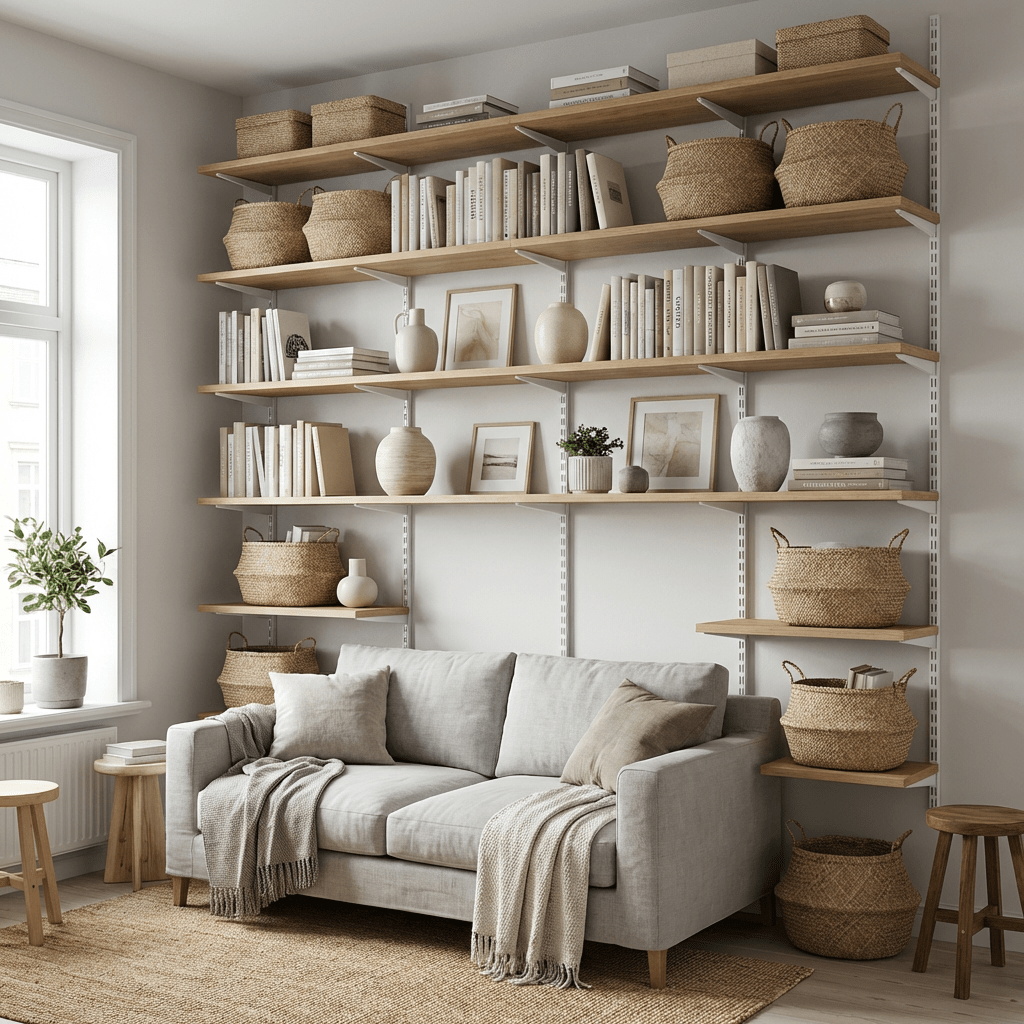
In a small apartment the floor is usually full by the second week, but most walls stay bare above the sofa back and the desk. A wall 10 feet wide and 8 feet high has 80 square feet of surface, and even a strip of it can hold what a bookcase would, without taking any floor.
Wall storage comes with two questions a bookcase doesn't: what the wall can hold, and what your lease allows. Each idea below says whether it needs screws and where it tends to go wrong.
1. Floating shelves that run high
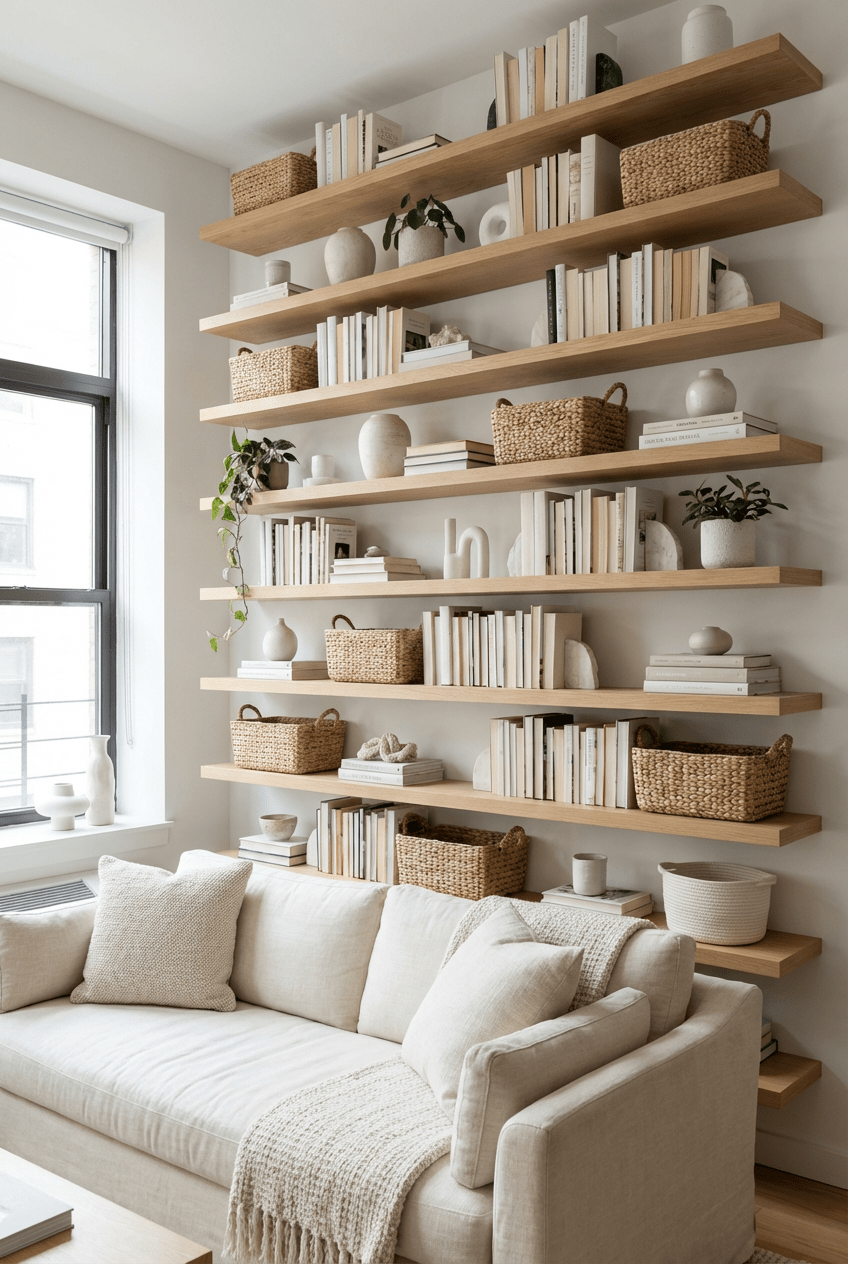
A stack of long shelves like the ones in the photo holds as much as a large bookcase while keeping the floor clear. Space them 12 to 14 inches apart for paperbacks and small baskets, or 15 inches for hardcovers and bigger bins. Shelves 8 to 10 inches deep hold most books without sticking out too far over a sofa or desk.
Most of the work is in the fixing. Floating shelf brackets need to go into studs, or into masonry with the right anchors, to carry a full row of books. A 36-inch shelf of hardcovers can weigh 30 pounds or more. If your walls are drywall and the studs don't line up with where you want the shelves, visible brackets screwed into studs are stronger than hidden floating hardware.
Use the top two shelves for things you rarely need and the shelves at arm height for daily things. Matching baskets on a few shelves hide the clutter, and leaving some gaps keeps a full wall from looking heavy.
Before you commit, find the studs with a stud finder or by tapping, and mark them with painter's tape. Studs in most US apartments sit 16 inches apart, so a 48-inch shelf can usually reach three of them. If the wall is concrete or brick, which is common in older city buildings, you'll need a masonry bit and sleeve anchors, and the shelves will hold far more than on drywall.
Tip: Ask your landlord before drilling a whole wall of holes. Many leases allow small picture-hanging holes but not anchors, and filling a dozen anchor holes neatly at move-out takes time.
2. A pegboard above the desk
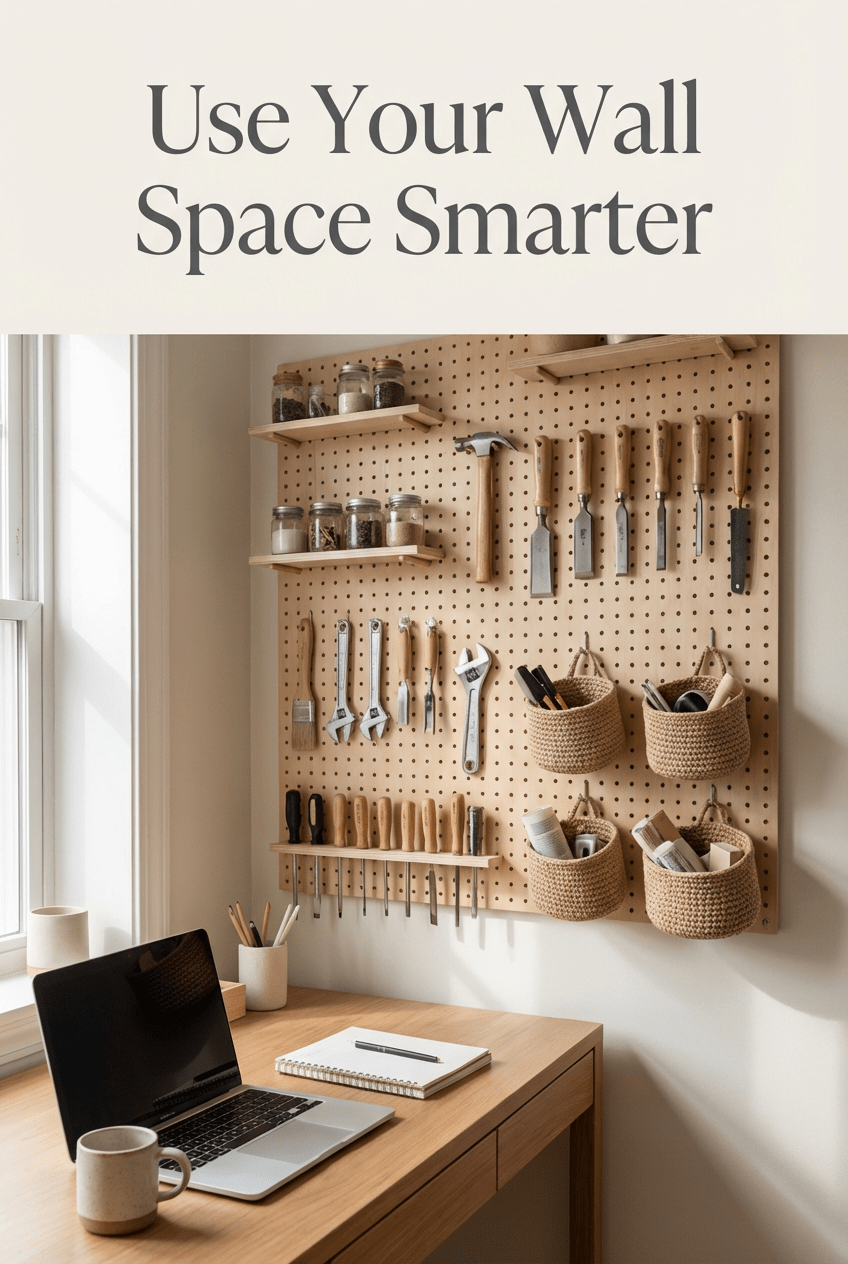
A pegboard over a desk keeps tools and cables off the work surface, and you can rearrange it in a minute. Standard boards have holes 1 inch apart that take the usual pegboard hooks, shelves and small bins. Wood boards like the one in the photo look warmer in a living space, and metal panels are stronger and take magnets.
Mount the board on spacers about half an inch from the wall so hooks can slot in behind. In a small home office, a 2-by-3-foot or 2-by-4-foot board is plenty. Hang the things you use daily between elbow and eye height, and keep the top of the board for things that can sit out of reach.
Small baskets clipped to the board, as in the photo, hold loose things like chargers and pens. Leave some empty holes: a board filled edge to edge looks busy and is harder to keep tidy.
Pegboard also works well inside a closet door or on the side of a tall bookcase, where nobody sees it. In a rental, a pegboard that leans on the desk and is held by one screw at the top, or that hangs from the shelf above with two strong hooks, avoids a row of holes in the wall.
3. A ladder shelf that leans instead of bolting
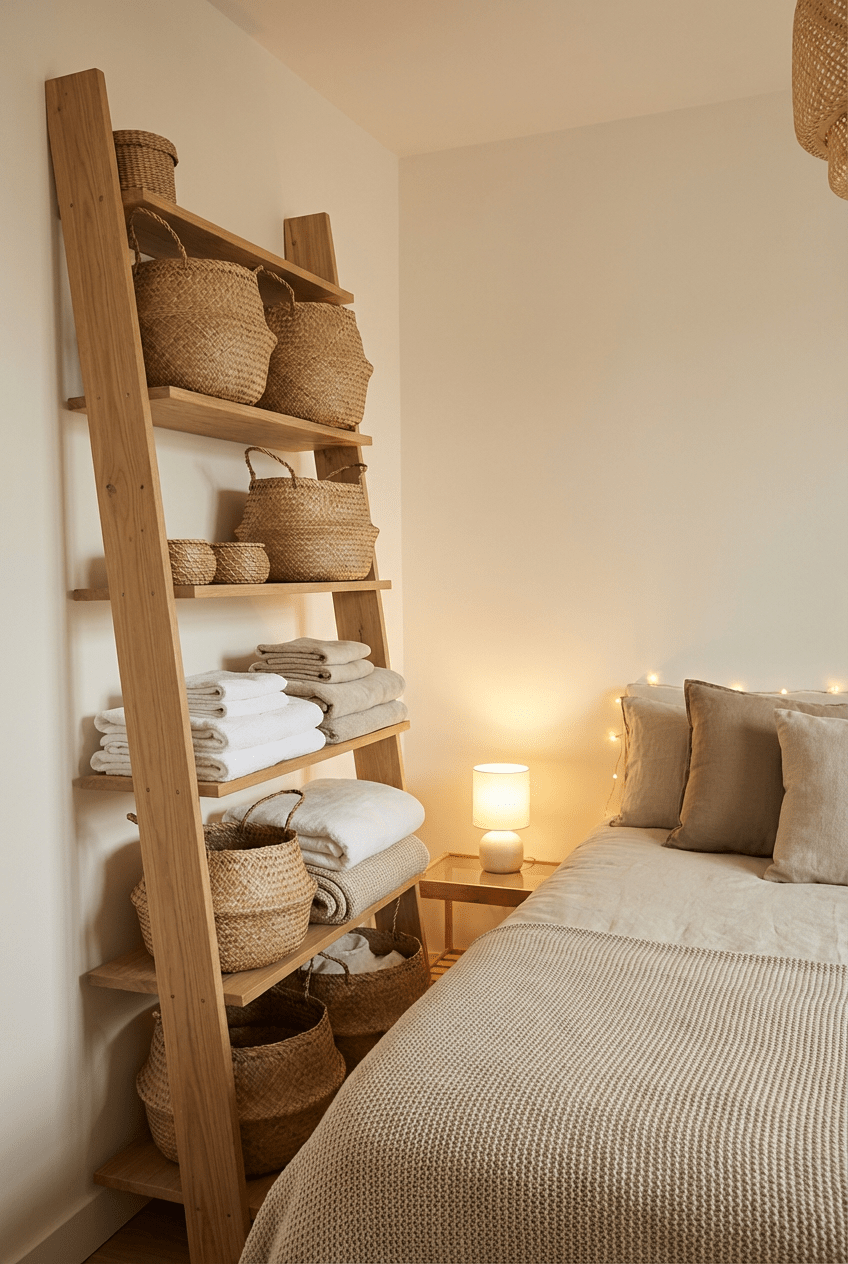
Leaning ladder shelves use height with a small footprint: deep at the bottom, about 14 to 16 inches, and narrow at the top. In a bedroom like the one in the photo, they hold folded towels, baskets of socks and a few books where a dresser wouldn't fit. Expect $60 to $150 for a solid wood one.
Even though they lean, they should still be anchored. Most come with a small wall bracket or strap at the top, which takes one screw, and it's worth using, especially with kids or pets. Put the heaviest things on the lowest and deepest shelves, and keep the top shelf for light things.
Baskets on the shelves keep things from sliding off the slight angle and hide what doesn't need to be on display.
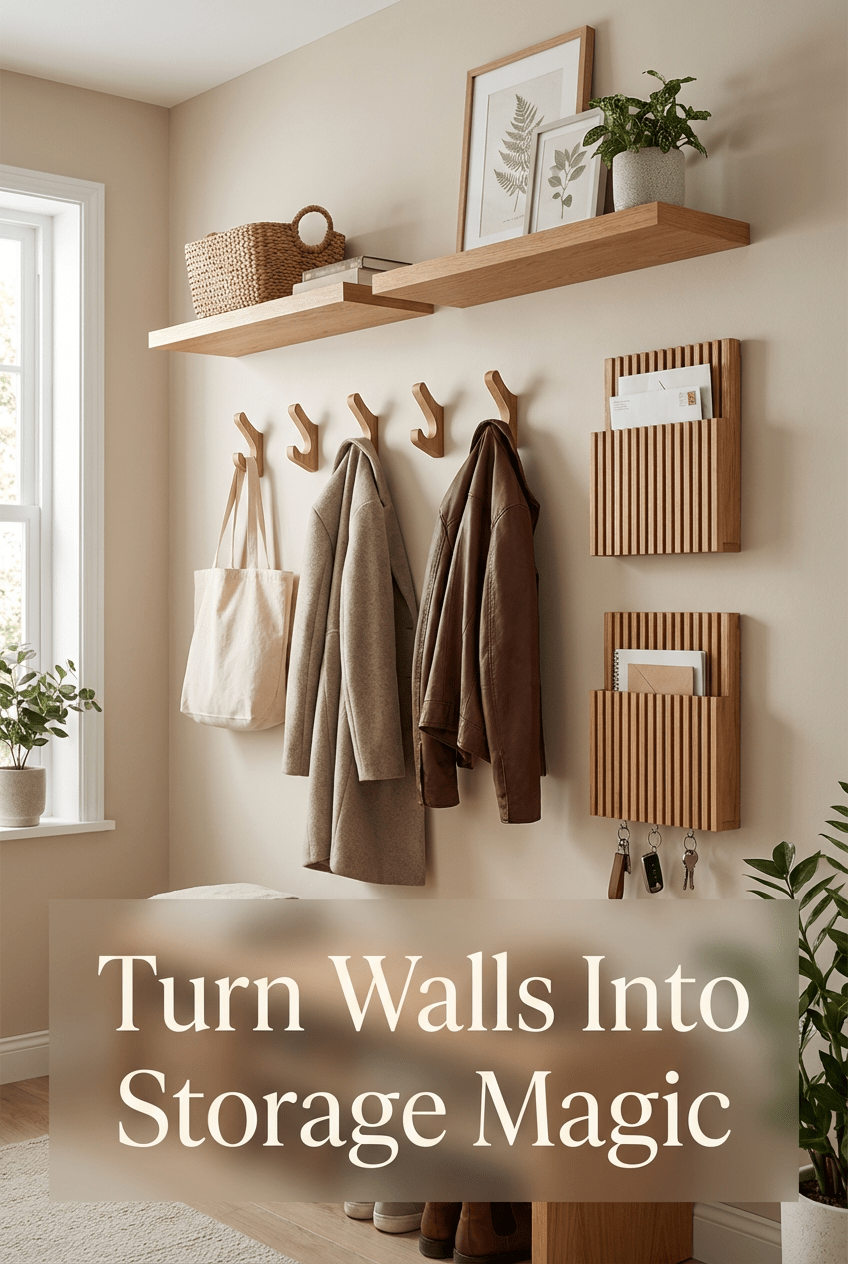
4. Hooks, pockets and one shelf by the door
An entry wall like the one in the photo does the job of a closet with only a few square feet of wall. A row of sturdy hooks holds coats and bags, wall pockets hold mail and papers, and a shelf above holds the things you only grab now and then, like a spare umbrella. Small key hooks near the door stop keys from going missing.
Hang coat hooks about 60 to 66 inches from the floor, and leave 8 to 10 inches between hooks so coats don't pile onto each other. A heavy winter coat and a full bag can pull out a weak fixing, so use screws into studs or proper anchors, not adhesive hooks.
Keep one hook free for guests. If shoes are the issue, a slim rack under the hooks or a small entryway setup with a bench keeps them off the floor.
Wall pockets are worth more than they look. Mail left on a table spreads across it within a week, while a pocket by the door gives every letter one place to land. Empty it once a week, recycle what you don't need and move bills to wherever you deal with them.
5. Tension pole shelving when you can't drill
Floor-to-ceiling tension poles hold shelves without any holes in the wall. A spring or screw mechanism wedges each pole between the floor and the ceiling, and shelves or baskets clip on at any height. They're common in bathrooms over the toilet, but taller corner units work in living rooms and kitchens too.
Check the ceiling height range on the box, since most fit roughly 7 to 10 feet, and read the weight limit per shelf, which is often only 10 to 25 pounds. They need a flat, solid ceiling. Popcorn texture, drop ceilings and old plaster can crack or let the pole slip. Tighten them again after a week, because they settle.
Tension systems are at their best in places where screws are hard to place, such as over a tiled bathroom wall or beside a window frame. In a kitchen corner, one with three or four baskets holds fruit, onions and bags of snacks off the counter. Avoid putting anything heavy or breakable near the top, where a knock could tip the pole.
6. Over-the-door racks
The back of every door is free storage. Over-the-door racks with shelves hold shoes, cleaning supplies or pantry items, and pocket organizers hold small things like scarves or toiletries. Most hang on hooks over the top of the door, so there's nothing to install.
Measure two things first: the gap between the top of the door and the frame, which the hooks must fit through, and the space behind the door when it's open. A deep rack can stop a door from opening fully or hit a light switch. On hollow-core doors, keep the load light, since heavy racks can damage the top edge.
Some of the most useful over-door storage is inside a pantry or coat closet, where the rack faces the shelves and nobody sees it. A narrow rack with adjustable baskets can hold spices, foil and cleaning sprays, and it frees a whole shelf. Over a bathroom door, a rack with two or three towel bars gives guests somewhere to hang a towel.
7. Wall planters for the plants on your windowsill
Plants take up more surface space than people expect. Wall planters and hanging shelves near a window move them off the sill and the counter. A grid of small planters or a single hanging shelf with three or four pots is easier to look after than a full plant wall.
Water adds weight, and drips add damage. Choose planters with a drip tray or a separate inner pot, and water them over a sink when you can. Trailing plants such as pothos and heartleaf philodendron grow well in the medium light most apartment walls get, while sun-loving plants like herbs need to stay close to a south- or west-facing window.
If you rent and can't drill, a plant stand with several tiers near the window does much the same job as wall planters, and hanging planters can hook onto a ceiling-mounted curtain rod that's already there. Check the rod and its brackets can take the weight of wet pots, which is often several pounds each.
Start with the wall you look at least, often the space above a door or a hallway, and keep the walls you see from the sofa calmer. For the rest of the apartment, see our guides to tiny apartment storage, room by room and under-bed storage.