
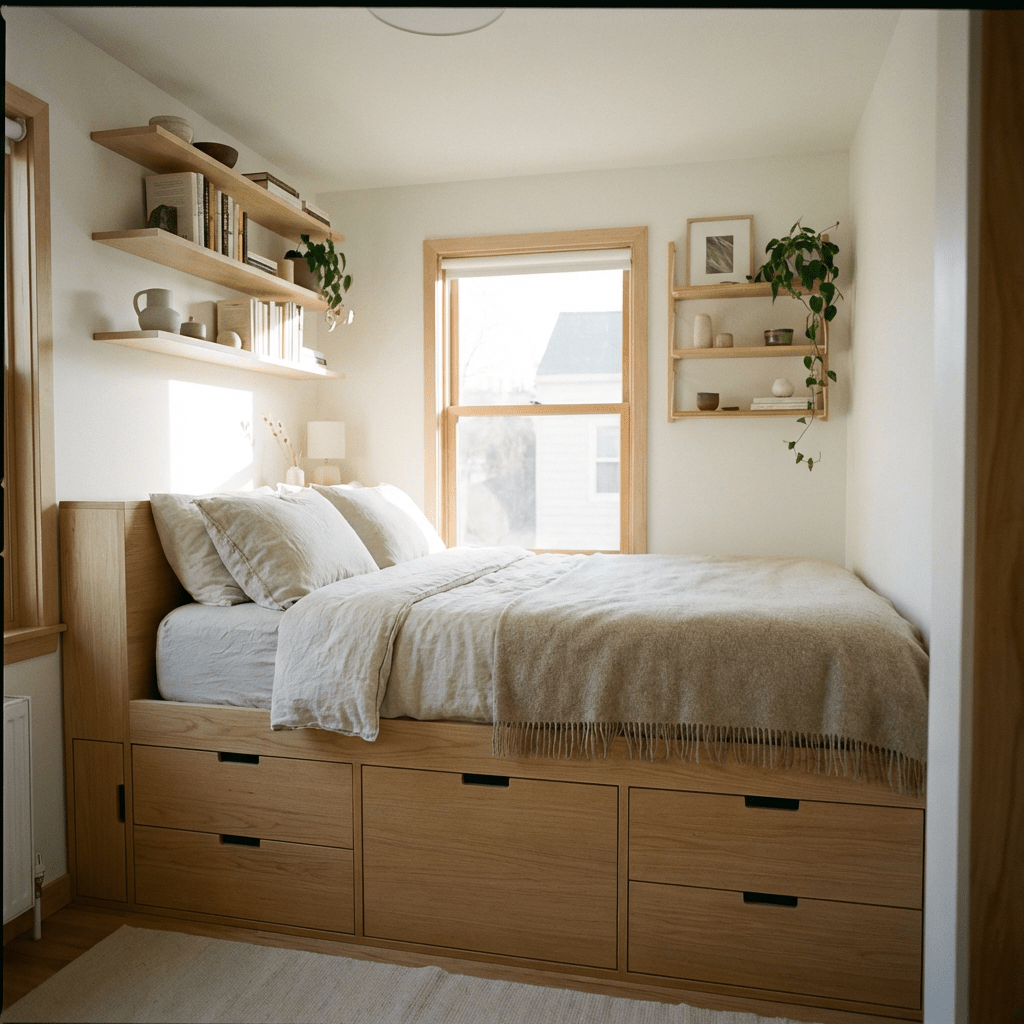
A small bedroom has to hold your clothes and bedding, usually with room for a bed, one other piece of furniture and a narrow path between them. Adding more furniture rarely helps. What does help is using the spaces the bed and walls already create, from under the mattress up to the ceiling.
The ideas below start with the biggest pieces, the bed and the wardrobe, then move to the smaller fixes that clear surfaces. Measurements are included where they decide whether something fits.
1. Start with a bed that has drawers
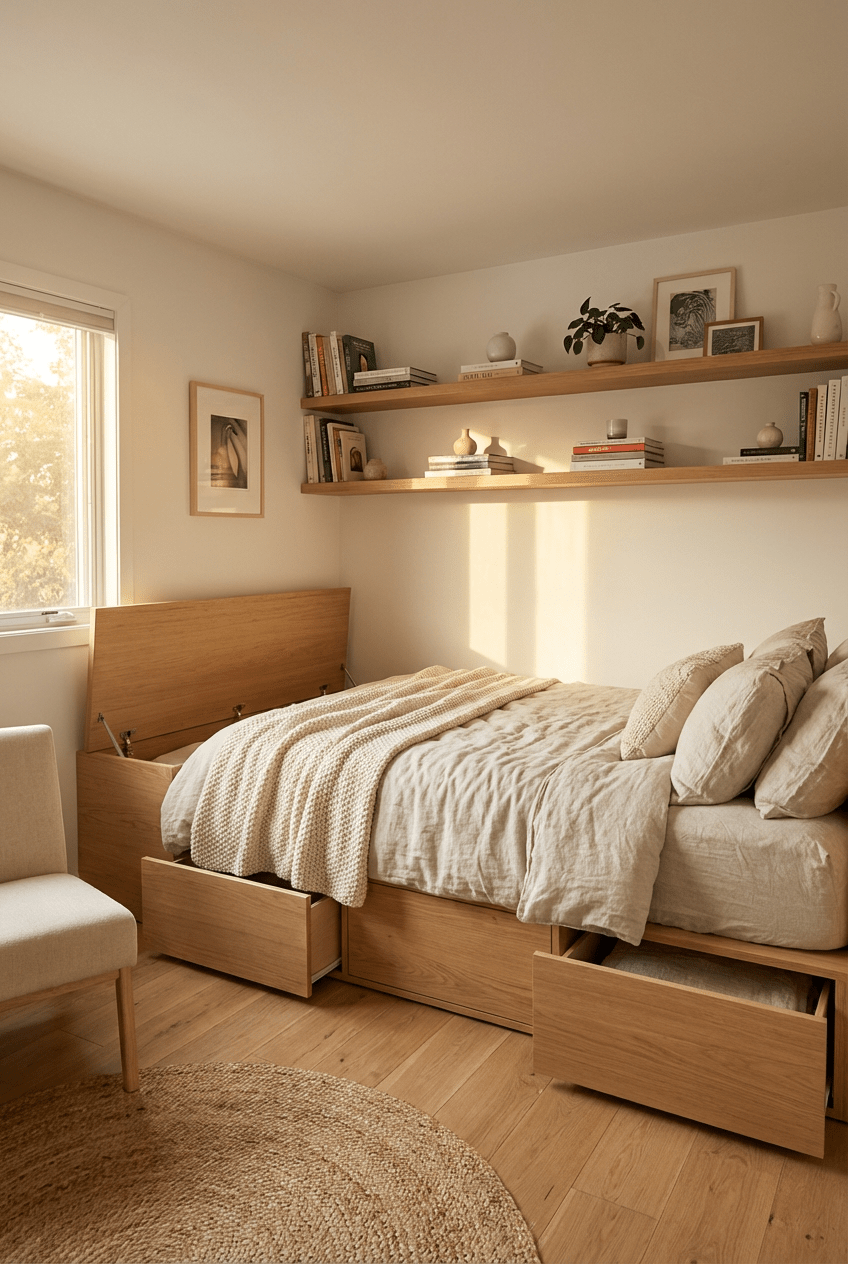
In most small bedrooms the bed covers more than a third of the floor, so making it hold things is the single biggest gain. A storage bed with deep drawers, like the oak one in the photo, can hold a whole season of clothes or all the spare bedding, and may let you drop a dresser altogether.
Drawers need about 20 inches of clear floor beside the bed to open fully. If the bed sits against a wall or the room is very narrow, a lift-up storage bed, which raises the whole mattress platform on gas struts, works better because it opens from the top.
If you're keeping your current bed, see our guide to under-bed storage ideas for bins, risers and bed skirts that make the same space useful.
2. Run shelves up to the ceiling
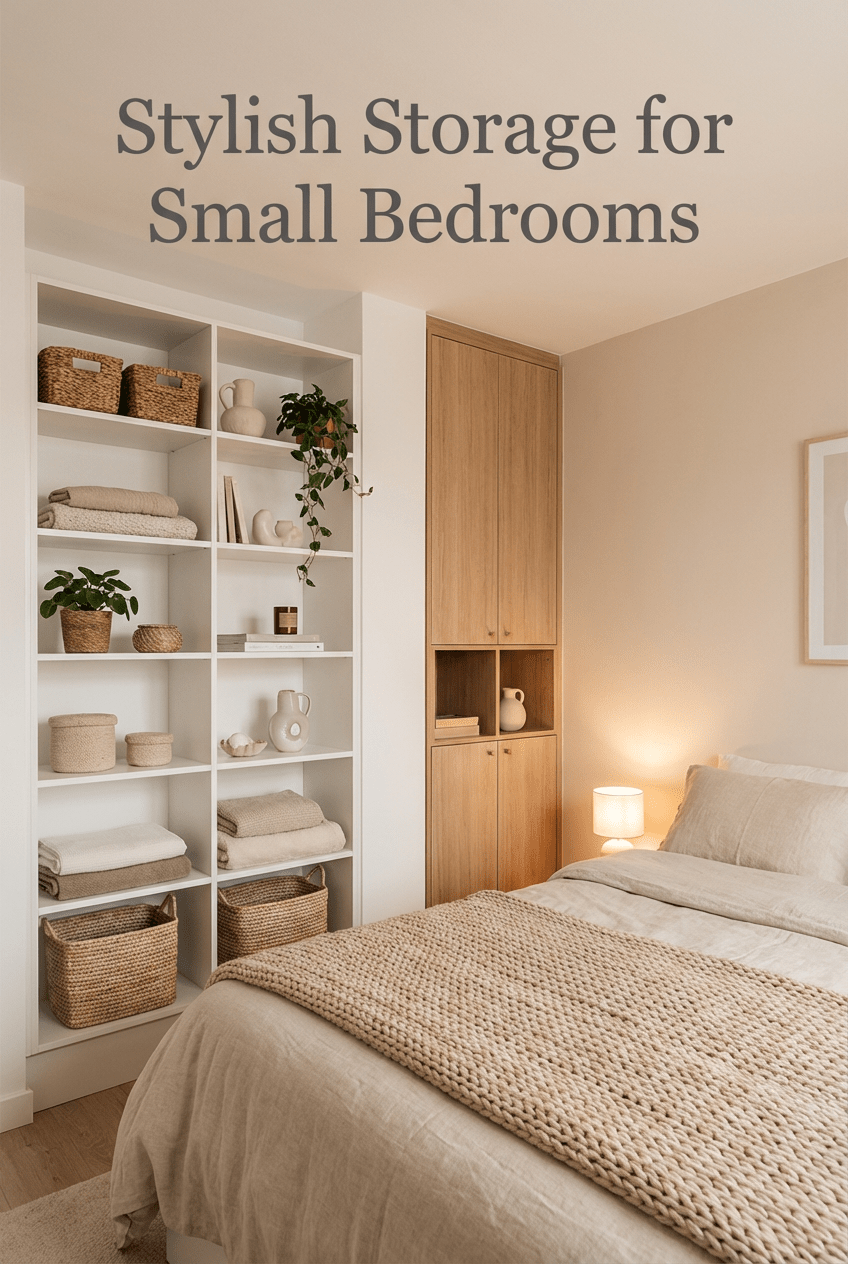
Floor-to-ceiling shelving, like the white unit in the photo, holds more than a dresser on the same footprint. Open shelves 12 inches deep fit folded sweaters and stacks of linens. Put baskets on the lower shelves for things you'd rather not see, and keep the top shelves for things you reach for a few times a year.
Freestanding units need an anti-tip strap screwed into the wall, which is a small, easy-to-fill hole and worth doing. A unit that runs right up to the ceiling looks built in and makes the room seem taller. Leave the shelves near the bed partly empty so the wall doesn't feel heavy when you're lying down.
Group things on each shelf by how often you use them, not by type. A shelf at waist height for the clothes you wear every week does more for a tidy room than a perfectly sorted top shelf. Fold sweaters rather than hanging them, since knits stretch on hangers and take up more room.
3. A ladder shelf in an unused corner
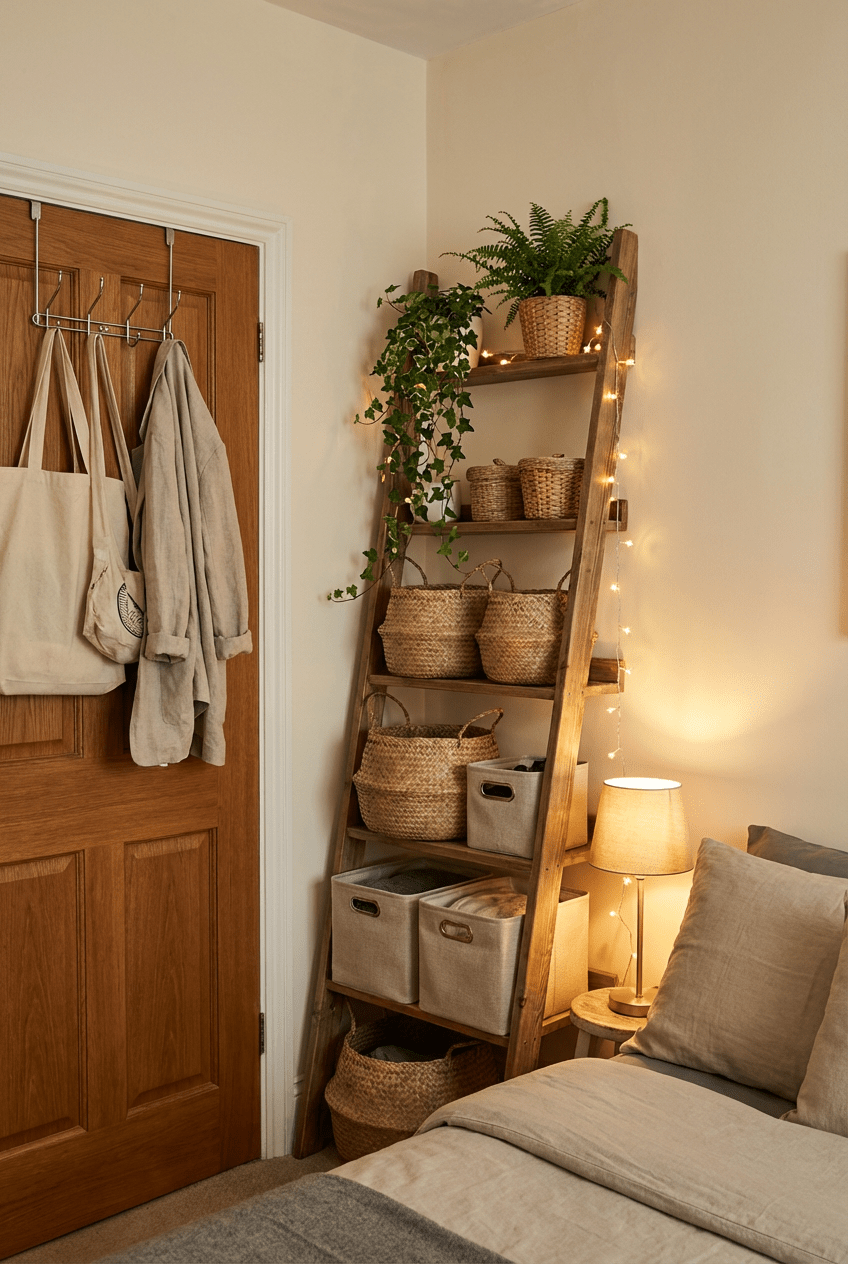
A leaning ladder shelf takes about as much floor as a laundry basket but holds four or five shelves of baskets and bins. In the photo, it sits in the corner between the door and the bed, a spot that's usually wasted.
Use lidded fabric bins on the lower shelves for small things like socks and chargers, and keep the top for a plant or a lamp. Anchor the top to the wall with the bracket most ladder shelves come with. They lean, but a pulled basket can still tip them.
Lights on the shelf, such as a string of fairy lights or a small lamp as in the photo, make a ladder shelf look deliberate rather than like extra storage. Keep cords away from fabric bins and use LED lights that stay cool.
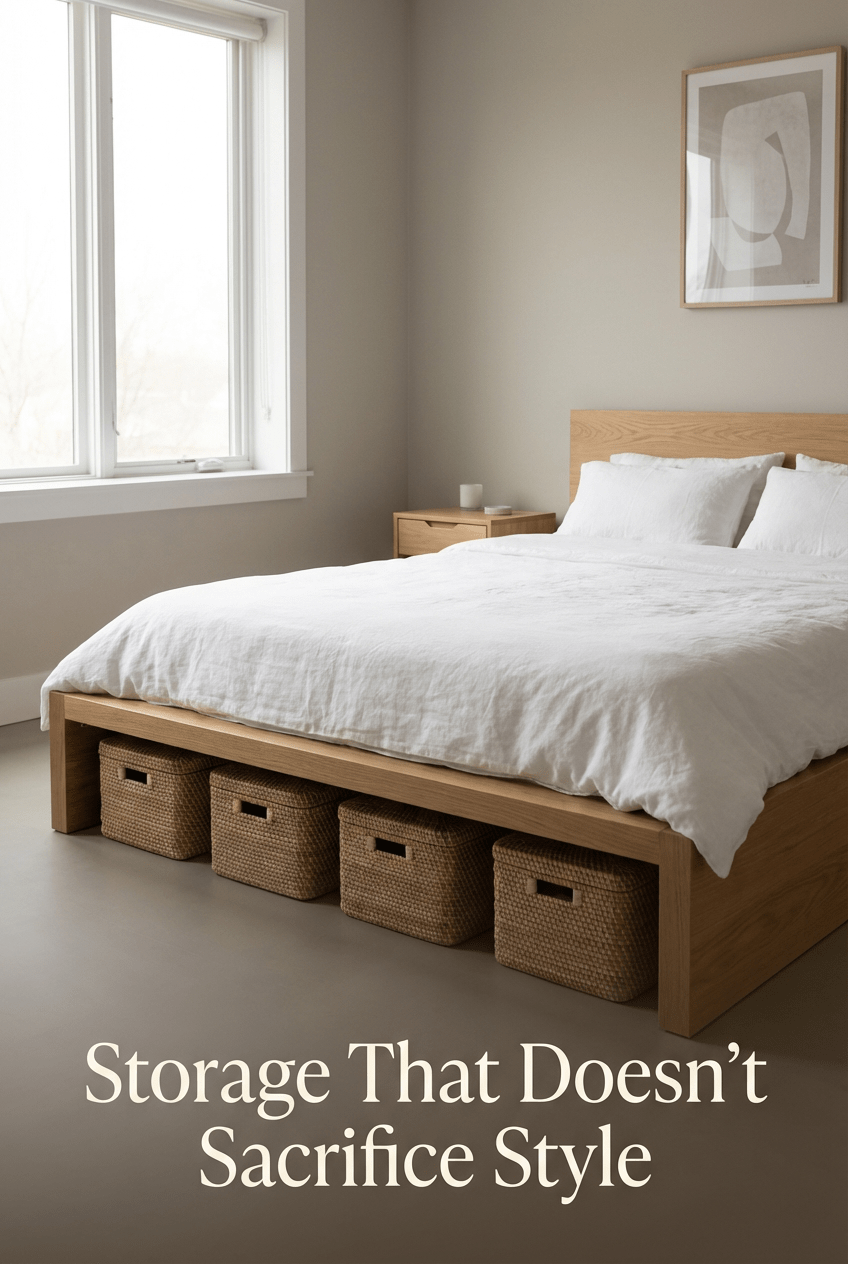
4. Baskets under an open bed frame
If your bed frame is open underneath, a row of matching baskets, as in the photo, turns the gap into storage you don't mind seeing. Measure the height from the floor to the frame and leave an inch of clearance. Baskets with handles on the front are easier to pull out.
Use them for things you reach for every week, like gym clothes or extra pillowcases, rather than long-term storage, which is better in lidded boxes that keep the dust out.
Matching baskets look calm because the eye reads them as one shape. Four identical baskets under a queen bed usually cost $60 to $120, and secondhand stores often have good woven baskets for much less if you don't mind them not matching exactly.
5. Wall-mounted nightstands
A floating nightstand or a shallow shelf beside the bed gives you a place for a lamp and a glass of water without taking floor space. Mount it at about mattress height, roughly 24 to 28 inches from the floor for most beds, and choose one with a small drawer if you want to hide chargers and medication.
If you can't drill, a clip-on bedside shelf that attaches to the bed frame, or a narrow side table 10 to 12 inches wide, takes up much less room than a standard nightstand.
Clear the top of any nightstand regularly. A nightstand is the bedroom equivalent of a kitchen counter, and a small tray for jewelry and earbuds keeps it from filling up with whatever comes out of your pockets.
6. A wardrobe with mirrored doors
In a bedroom without a closet, or with a tiny one, a freestanding wardrobe adds hanging space. Mirrored doors give you a full-length mirror without using a wall, and the reflection makes a small room look larger. Sliding doors are better than hinged ones in a narrow room, since they need no space to swing open.
Measure the ceiling height, the doorway and any stairs before you buy, because tall wardrobes are often delivered flat-packed in long boxes. Standard wardrobes are about 22 to 24 inches deep, which fits a hanger. Anchor it to the wall.
Inside, double the hanging space by adding a second rail or a hanging rod extender for shirts and folded pants, and use the floor of the wardrobe for a shoe rack or a couple of bins. A shelf above the rail takes boxes of off-season clothes.
7. A pegboard or grid panel for jewelry and accessories
Jewelry and sunglasses clutter a dresser top faster than anything else. A small pegboard or wire grid panel above or beside the dresser, with hooks and a narrow shelf, gives each item a place you can see.
Keep it small, around 2 by 2 feet, so it doesn't overwhelm the wall. A grid panel can hang from two picture hooks, which leaves fewer holes in a rental than a mounted board.
Hang the things you wear most often at the front and at eye height. A few small hooks on the side of the panel are handy for necklaces, which tangle in drawers.
8. A narrow chest of drawers for the gap
Many bedrooms have an awkward gap of 12 to 20 inches, beside the wardrobe or the window. Tall, narrow chests of drawers are made for those spaces and often hold as much as a wide, low dresser because they go up instead of out.
Choose one with drawers that close fully even when full, and anchor it to the wall with an anti-tip kit. Narrow, tall furniture tips more easily than wide furniture, especially if the top drawers are opened and loaded.
Use the top for a lamp and a small tray, and keep the drawers for things you reach for daily, like underwear and socks. A narrow chest also works well inside a large closet, under the hanging clothes.
9. A headboard with shelves or cubbies
A headboard with built-in shelves or cubbies holds books and a phone where you can reach them in bed, and can replace one or both nightstands. Bookcase headboards are usually 8 to 12 inches deep, so check that the bed and headboard together still leave a comfortable walkway at the foot of the bed.
A simple alternative is a single long shelf mounted above the bed, about 12 inches above the top of the mattress, which holds a few books and a lamp. Keep anything heavy or breakable off it.
Another option is a headboard that's simply a row of shallow cabinets, or a pair of wall-mounted cabinets on either side of the bed. These can hold bedding or books and make the bed wall look built in.
10. Hooks and organizers on the back of the door
The back of the bedroom door is free space for robes and tomorrow's outfit. An over-the-door hook rack, like the one in the photo above, needs no tools and costs $10 to $25. For shoes or small items, a clear pocket organizer holds more.
Make sure the door still closes properly and doesn't hit furniture when it swings open with things hanging on it.
If the bedroom closet has doors, use the inside of those too. A slim rack for belts and scarves, or a hanging shoe organizer, makes the most of space that's otherwise just painted wood.
11. A storage bench at the foot of the bed
A bench with a lift-up lid at the foot of the bed holds spare blankets and off-season clothes and gives you a seat for putting on shoes. Keep it a few inches narrower than the bed and about 16 to 18 inches deep, so it doesn't block the path around the bed.
Choose a lid with a soft-close hinge. Our post on storage ottoman ideas covers more options.
A bench with a cushion also gives you a place to lay out tomorrow's clothes or to fold laundry, which saves throwing it on the bed.
12. Shelves in an alcove or beside a chimney breast
Older apartments often have alcoves, recesses or the sides of a chimney breast that are hard to furnish. Shelves fitted into an alcove look built in and hold far more than a freestanding piece. Shelves on brackets screwed into the side walls of the alcove are often stronger than floating ones.
If you rent and can't fix shelves into the walls, a freestanding shelving unit cut or chosen to fit the alcove width does almost the same job, and comes with you when you move.
Measure the alcove at the top, middle and bottom, since older walls are rarely straight, and cut shelves to the narrowest measurement. A small gap at the ends is easier to hide than a shelf that won't fit.
Begin with the bed and the wall above it, then work outward to the smaller pieces. For more room-specific ideas, see our guides to vertical storage and storing winter clothes in a tiny apartment.