
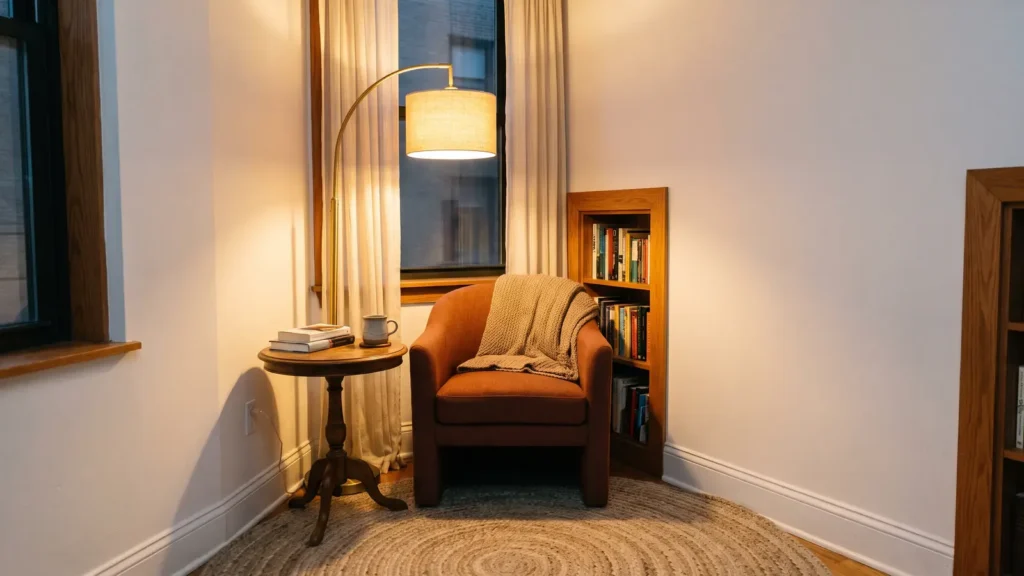
A reading nook sounds like something that needs a bay window, a built-in bench and a spare room. In reality, all it takes is one corner, one comfortable chair and one good lamp, and almost every small living room has a spot that can hold all three. As the evenings get longer, a dedicated place to read, knit or drink a cup of tea away from the TV and the laptop becomes one of the most-used corners in the apartment.
The trick in a small space is choosing pieces that fit the corner instead of crowding it, and lighting it properly so you actually want to sit there. The steps below set up a cozy reading nook in a small living room, with measurements, rough costs and renter-friendly options that don’t need a drill.
1. Find the corner that already works
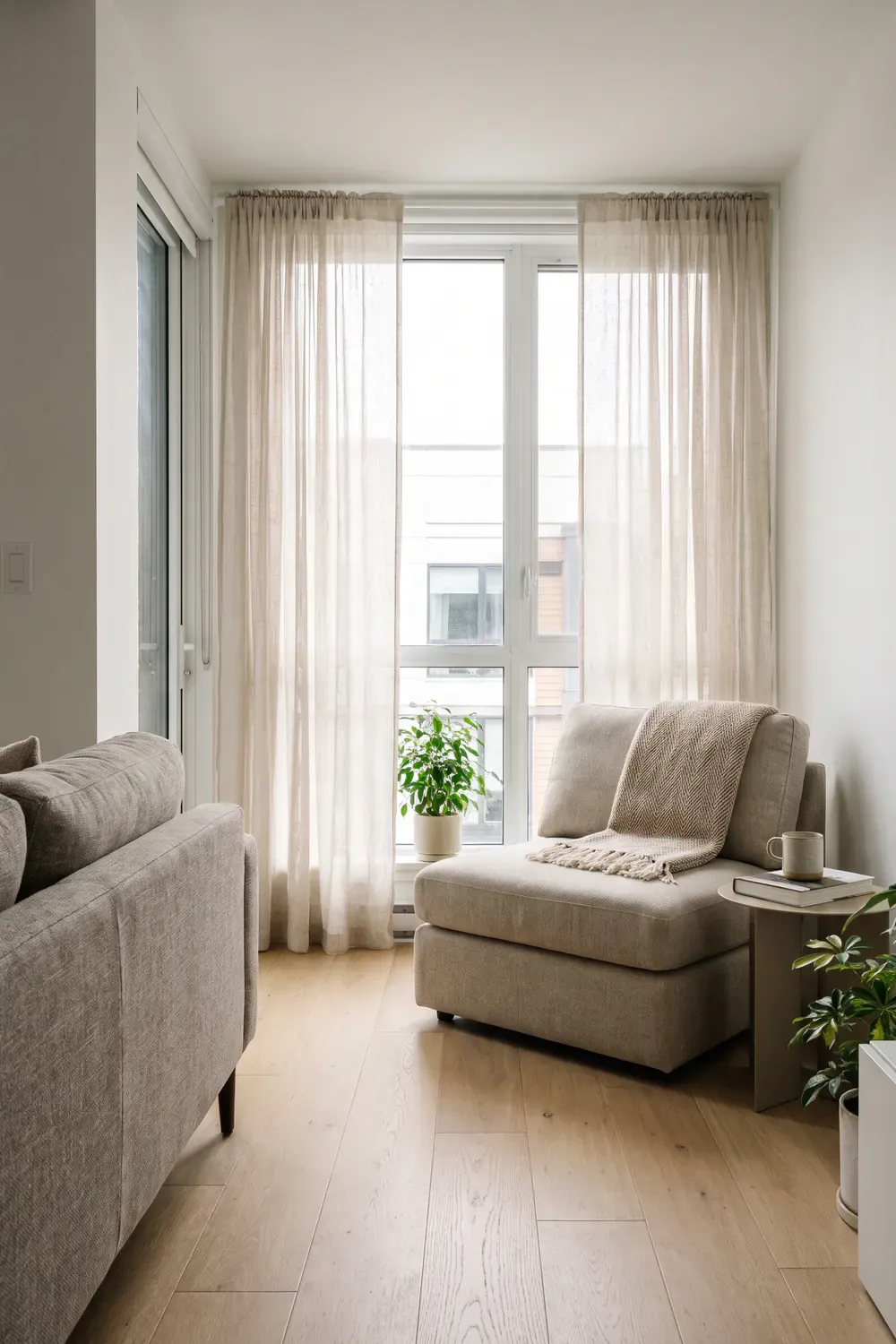
Look for a corner you walk past rather than through. The best reading nook spot is out of the main walkway, close to natural light and away from the TV, so the nook feels separate even though it’s in the same room. A corner beside a window is ideal for daytime reading. The end of a sofa, the space beside a bookcase or the gap between a window and a radiator can all work too.
Measure before you buy anything. A compact reading nook needs roughly 3 by 3 feet of floor space for a small armchair, plus a little room for a side table and a lamp. Leave at least 30 inches of walkway in front of it so the corner doesn’t become an obstacle. If you have less space, a slipper chair, a floor cushion or a small bench can still make a nook in a 2-by-2-foot spot.
Notice how the light moves through the day. A spot that’s bright in the morning may be dim after lunch, and a corner by a drafty window may be lovely in spring and chilly in January. Sitting in the spot with a book for an evening before you commit is the simplest test.
- Out of the main walkway and away from the TV
- Near a window for daytime reading
- About 3 by 3 feet for a compact chair, side table and lamp
- At least 30 inches of clear walkway in front
2. Choose one chair that fits the corner
The chair is the whole nook, so it’s worth getting right. In a small living room, look for a compact armchair around 28 to 32 inches wide rather than a deep lounge chair that can easily be 36 inches or more. A seat depth of about 20 to 22 inches suits most people for upright reading, and a higher back gives your head and shoulders somewhere to rest.
Armless slipper chairs take even less space and work well in tight corners. Swivel chairs are handy if the nook sits between a window and the TV, because you can turn toward either. If you’re short on floor space, a chaise or a deep chair can double as a guest seat, but only if it doesn’t block the room. Try the chair in a store if you can, and sit in it for a few minutes with a book.
You don’t need to spend much. Secondhand armchairs from thrift stores and online marketplaces are often solid and inexpensive, and a new cover, a throw or a pair of cushions can make an old chair look new. New compact armchairs commonly cost $150 to $450 at retailers like IKEA, Target and Wayfair.
Tip: Measure your doorway and hallway before you bring a secondhand chair home. A chair that won’t fit through the door is an expensive mistake.
3. Get the reading light right
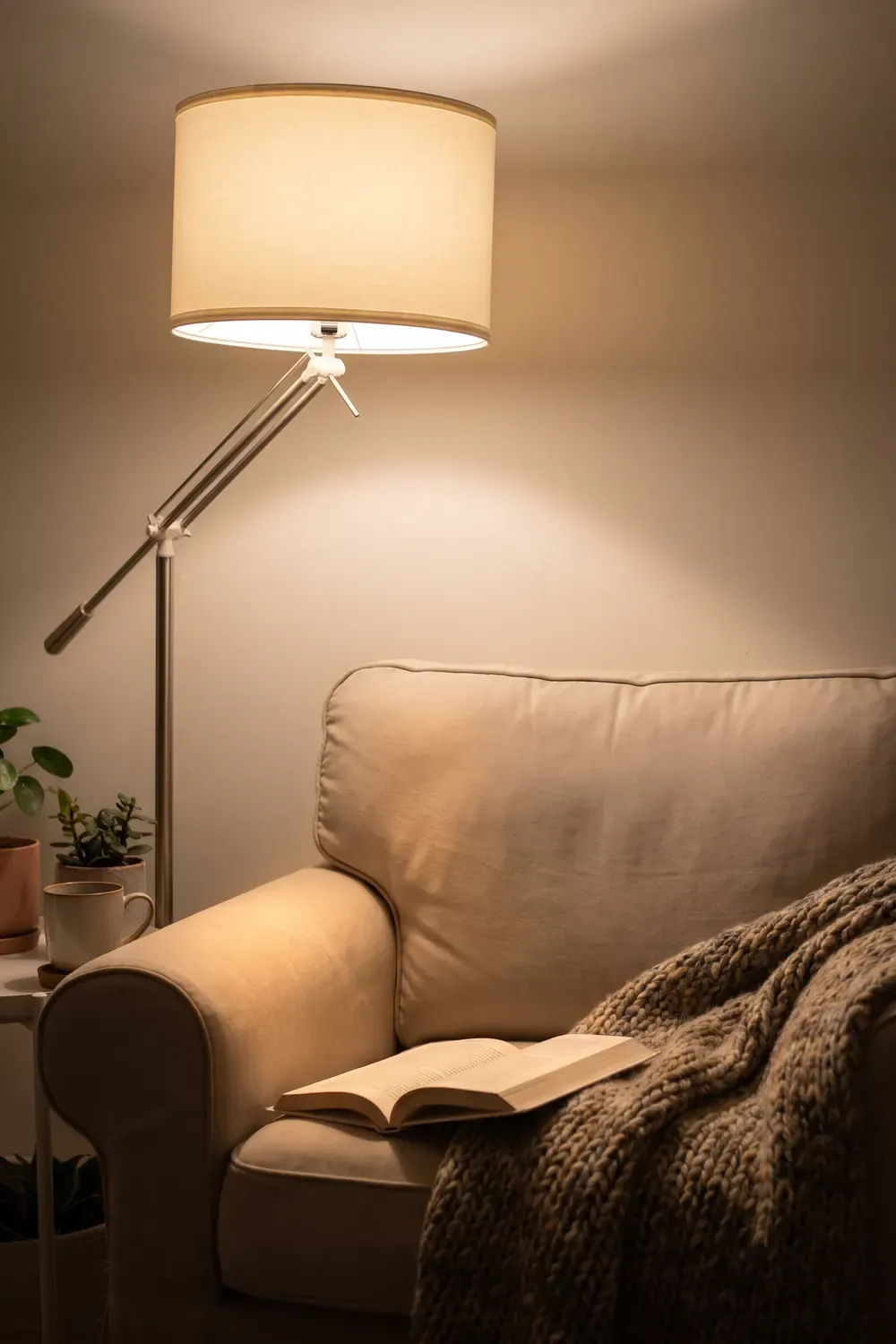
Good light is what turns a chair in a corner into a reading nook. The ceiling light is rarely enough, and it usually creates shadows on the page. Place a floor lamp just behind and to the side of the chair, with the bottom of the shade at roughly shoulder height when you’re sitting, so light falls over your shoulder onto the book without shining in your eyes.
For the bulb, look at brightness rather than wattage. Look for about 800 lumens or more, which ENERGY STAR lists as the equivalent of an old 60-watt bulb, and use a warm white color temperature of about 2700K to 3000K for a cozy evening feel. Adjustable or swing-arm lamps let you aim the light precisely, and arched lamps reach over the chair without a table.
If there’s no floor space for a lamp, try a plug-in wall sconce. Many come with a cord cover, and you can mount them with a single screw or a strong removable hook, depending on your lease. A clip-on lamp on a bookcase is another space-saving option.
- Lamp behind and beside the chair, shade at about shoulder height
- At least 800 lumens (about a 60-watt equivalent)
- Warm white, 2700K–3000K, for evenings
- No floor space? A plug-in sconce or clip-on lamp
4. Add a small place for your cup and book
A reading nook needs a surface within easy reach: a spot for a mug, your phone, glasses and the book you’ve just put down. A small side table about 18 to 22 inches across is plenty. Choose one whose top sits roughly level with the chair’s arm, or a couple of inches below, so you can reach it without twisting.
In a tight corner, a C-shaped table slides under the chair arm or the edge of the seat and takes almost no floor space. A sturdy stool, a stack of large books with a tray on top or a small wall ledge beside the chair works too. Round tables are easier to walk past than square ones in a narrow spot.
Keep the table clear except for what you use there. A coaster, a small plant and the book you’re reading are enough. Anything more turns into a drop zone for keys and mail.
Tip: A tray on the side table keeps small things together and makes it easy to clear the table when you need it for something else.
5. Store books without building anything
You don’t need a wall of built-ins to keep books near your chair. A narrow bookcase about 10 to 12 inches deep fits beside most chairs and holds more than you’d expect. If you want something taller, anchor it to the wall with an anti-tip kit, which is a sensible safety step and usually worth asking your landlord about if you rent.
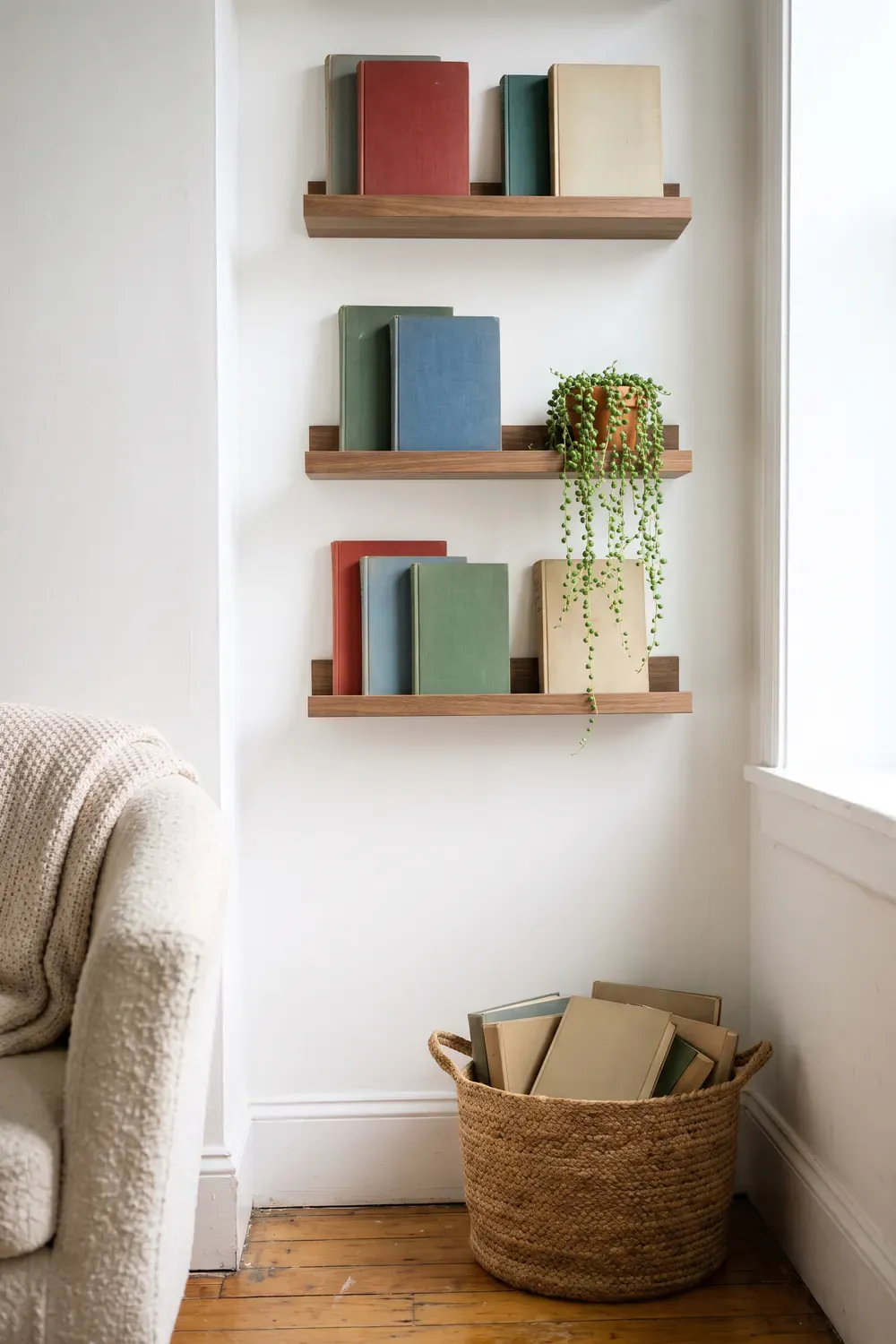
Picture ledges are a good alternative in a small living room. A few slim ledges on the wall beside the chair hold books face-out, so the covers double as artwork and the wall stays slim. Use the hardware that comes with them for a secure hold, or choose light ledges that can be mounted with strong removable strips. For more ideas, see our DIY floating shelves and built-in bookshelf hacks.
A basket on the floor is the easiest option of all. Keep the books you’re currently reading in it, along with a throw, and swap them out each month so the nook never feels crowded.
- Narrow bookcase about 10–12 inches deep, anchored to the wall
- Slim picture ledges for face-out books
- A floor basket for current reads and a throw
6. Define the nook with a rug and textiles
A rug tells the eye that the corner is its own space. A small round rug about 4 to 5 feet across works well under a single chair and side table, and its curved edge softens the corner. If your living room already has a large rug, layering a smaller one on top in a different texture, such as a sheepskin or a wool flatweave, achieves the same effect.
Then add softness. A throw over the arm, a lumbar cushion for back support and a footstool or pouf make a basic chair far more comfortable for long reads. A pouf can also serve as an extra seat or side table when you have guests, which earns its place in a small room.
Keep the colors connected to the rest of the living room so the nook looks planned rather than squeezed in. Choosing one accent color from your sofa cushions or curtains for the chair or throw is an easy way to do this. Our ideas for cozy living room textures show how to layer fabrics without clutter.
Tip: Use a rug pad under a small rug on a hard floor. It stops the rug from sliding when you get up and protects rental floors.
7. Try a bench under the window
If the best light is under a window and a chair won’t fit, a bench can become a window seat without any building. A storage bench or a low bookcase laid on its side, about 16 to 18 inches high, topped with a firm cushion and a few pillows, turns the space under a window into a reading spot with storage underneath.
Check the measurements before you buy. The bench should sit below the windowsill so it doesn’t block the window, and it shouldn’t cover a radiator or heating vent. A seat cushion about 3 to 4 inches thick is comfortable for sitting, and back cushions propped against the wall make it easy to lean back.
A bench is also flexible. Pull it out for extra seating when you have guests, or use the storage inside for blankets and books. It’s a good option for narrow living rooms where an armchair would stick out into the walkway.
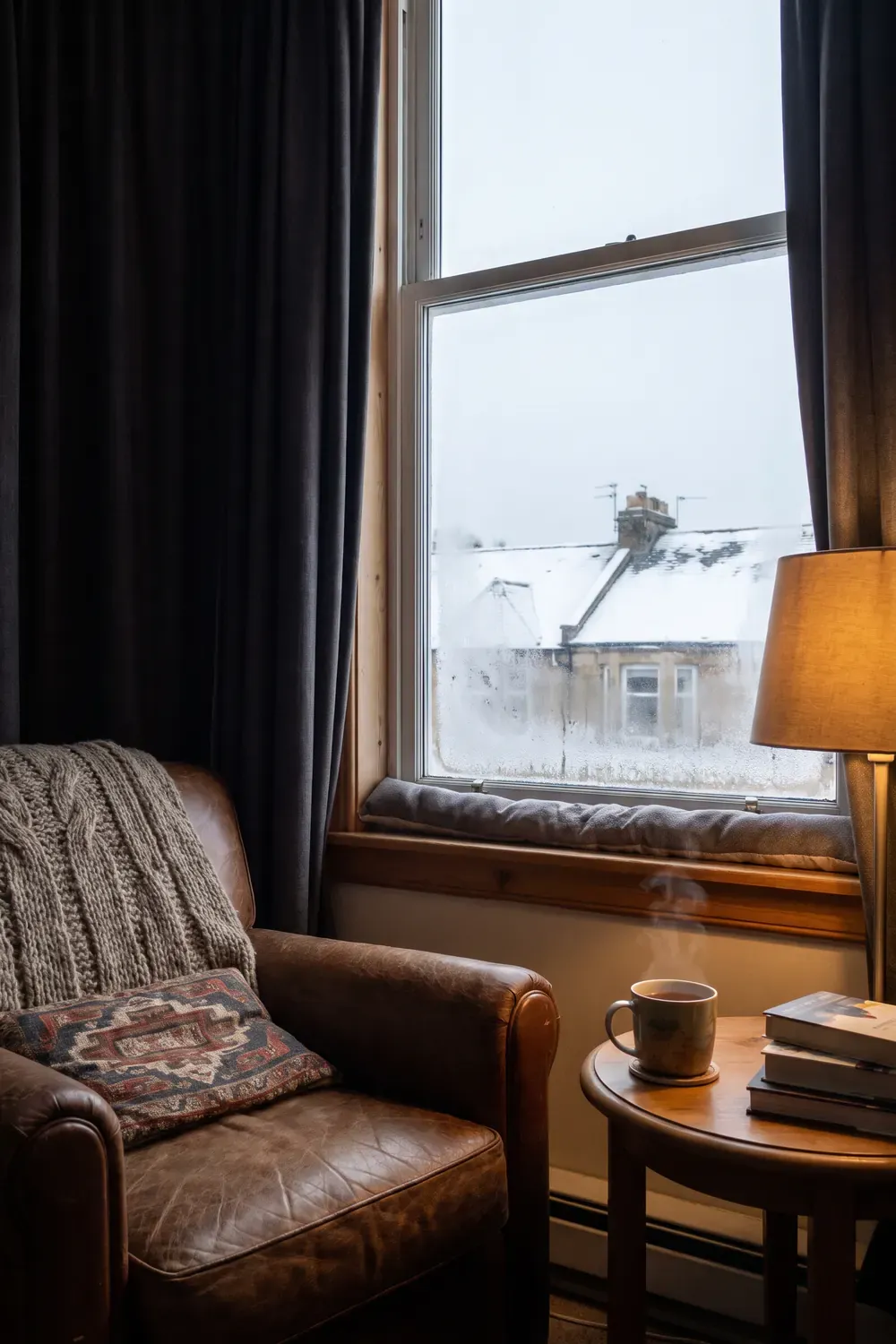
8. Keep a window nook warm in winter
Windows are wonderful for daytime reading but can be cold in winter, especially in older apartments. Lined or thermal curtains that you can draw in the evening make a big difference, and a draft stopper along the sill or at the bottom of a drafty window helps further. Moving the chair a few inches away from the glass reduces the chill without losing the light.
Keep a throw and a cushion in the nook so you’re comfortable as soon as you sit down. If you want extra warmth, a small space heater can work, but follow the safety basics: keep it at least 3 feet away from the chair, curtains and books, plug it directly into a wall outlet and switch it off when you leave the room.
For more ways to cut drafts without damaging your rental, see our guide on how to winterize your apartment as a renter.
- Lined or thermal curtains drawn in the evening
- A draft stopper along the sill
- Chair a few inches back from the glass
- Any space heater at least 3 feet from fabrics and books
9. Keep it from turning into a clutter corner
The biggest risk for a reading nook in a small living room is that it slowly fills with laundry, bags and unopened mail. Keep the nook for reading and relaxing only, and give everything else a home elsewhere. A simple rule helps: if it isn’t a book, a blanket or a cup, it doesn’t stay in the nook overnight.
Limit the book pile. Keep three or four current reads in the basket or on the table and return the rest to the shelf. Rotating them keeps the corner looking fresh and makes it easier to pick something up.
Finally, use it. Ten minutes with a book before bed or a cup of coffee in the morning light is what makes a small nook worth the space. A corner you use every day earns its place in a small living room far more than a perfect one nobody sits in.
Tip: Keep a small lidded basket nearby for chargers and glasses so the side table stays clear.
Common questions
How much space do you need for a reading nook?
About 3 by 3 feet for a compact armchair, a small side table and a floor lamp, plus about 30 inches of walkway in front.
What is the best lamp for a reading nook?
An adjustable or arched floor lamp placed behind and beside the chair, with a warm bulb of about 800 lumens or more.
Can you make a reading nook without a window?
Yes. For evening reading, good lamp light does more than daylight. Choose a quiet corner away from the TV and walkways.
What chair is best for a small reading nook?
A compact armchair 28 to 32 inches wide with a seat about 20 to 22 inches deep, or an armless slipper chair for very tight corners.
Try the chair in the corner for a few evenings before buying anything else; the lamp and side table are easy to adjust once you know where you actually sit. Add a rug, a throw and a little book storage, and you have a corner that feels like its own room without losing any of your living space.
If you’re rearranging to make room, our studio apartment living room layouts and rug ideas for small living rooms are good next reads.