
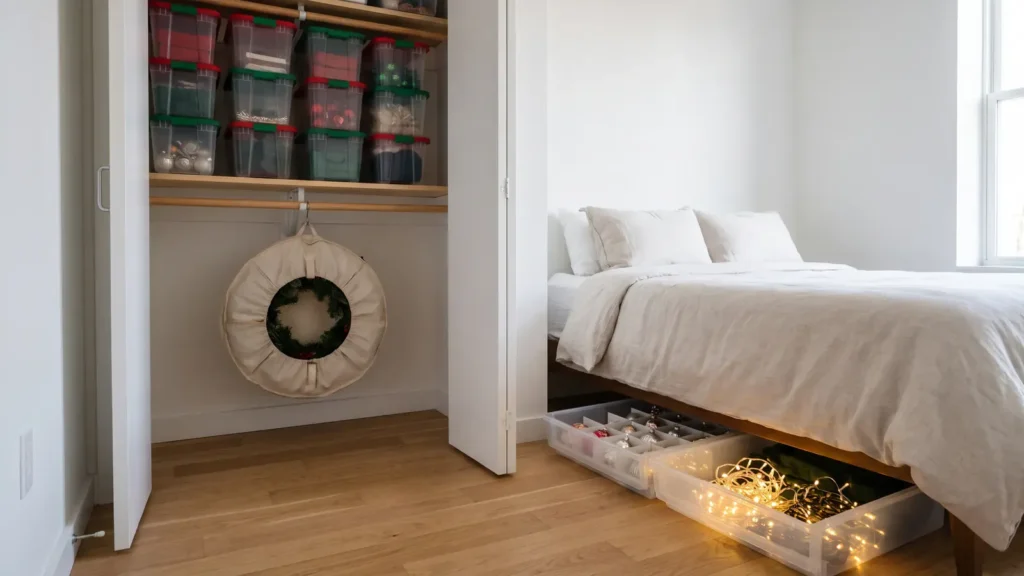
Holiday decorations are easy to love for six weeks and hard to live with for the other forty-six. In a house they go to the garage, the attic or the basement. In a small apartment there’s none of that, so the boxes end up wedged into the coat closet, stacked in a corner of the bedroom or crushed under the bed, and half the ornaments are broken by the time you open them again.
Most apartments have enough hidden space for a sensible amount of holiday decor. Edit before you pack, choose containers that fit the exact spots you have, and pack each type of decoration so it survives the year. Below is where holiday decorations can actually live in a small apartment, with sizes, rough costs and the mistakes that cause broken glass and dead lights.
1. Edit before you store anything
The cheapest storage is the decoration you no longer keep. Before you buy a single bin, take everything out and sort it into three piles: things you used and loved last year, things you didn’t use, and things that are broken or tired. Be honest about the second pile. If a box of ornaments or a giant inflatable has stayed packed for two seasons, it’s taking space from things you actually use.
Set a limit that fits your apartment. One way is to decide on a number of bins, say two or three standard bins plus the tree, and let everything compete for that space. Fragile family ornaments and handmade pieces get first priority; mass-produced decorations you can replace cheaply come last.
Donate decorations in good condition to a thrift store, a school, a church or a local Buy Nothing group early in the season, when people are looking for them. Lights that don’t work, cracked ornaments and faded garland can go. Recycling rules for old lights vary, and some hardware stores collect them in November and December.
- Sort into: used and loved, unused, broken
- Decide on a bin limit that fits your space
- Donate early in the season, when people want decorations
2. Pick bins that fit the spaces you have
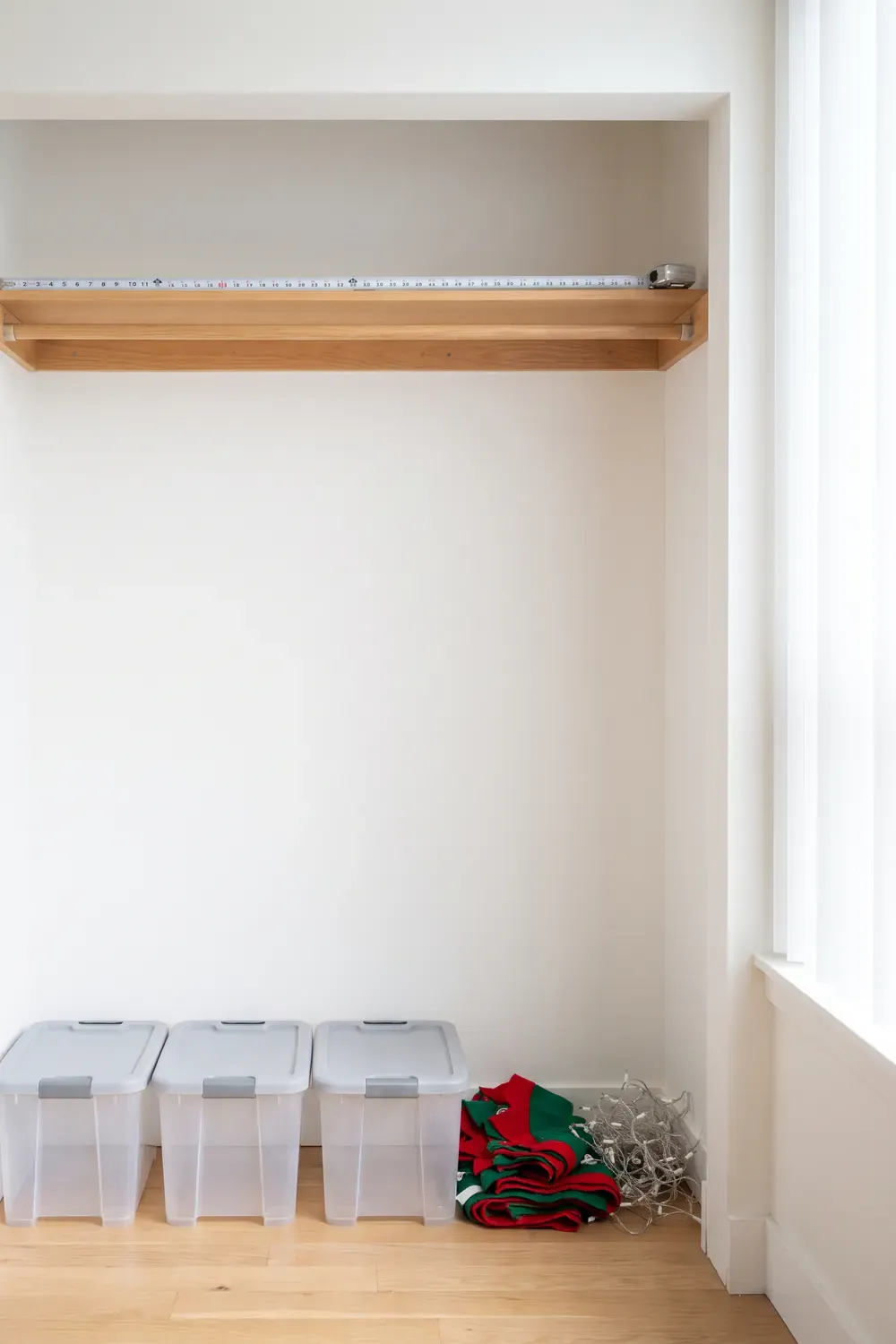
Measure first, then buy. Note the height, width and depth of your closet’s top shelf, the clearance under your bed, the floor of the coat closet and any space on top of a wardrobe. Bins that are even an inch too tall won’t slide under a bed or onto a shelf, and that’s the most common storage mistake.
Clear plastic bins with snap-on lids are the best all-round choice. You can see what’s inside, they keep out dust and moisture far better than cardboard, and identical bins stack neatly. Buying several of the same size makes a closet look calmer and lets you swap bins between shelves. Expect roughly $8 to $20 per bin for common sizes at stores like Target, Walmart and IKEA.
Colored lids, such as red or green, make holiday bins easy to spot among other storage. Add a simple label or a photo of the contents on the end that faces out so you can find the lights without opening every bin.
- Measure shelf height, under-bed clearance and closet floor space
- Clear, lidded plastic bins in one or two sizes
- A label or contents photo on the end that faces out
Tip: Skip cardboard for long-term storage. It absorbs moisture, attracts pests and crushes when stacked.
3. Use the space under the bed
Under the bed is usually the largest unused storage space in a small apartment. Many bed frames leave 6 to 7 inches of clearance, enough for shallow under-bed bins that hold flat items like tree skirts, stockings, table runners, wrapping paper and wound lights. Bins with wheels or a handle are easier to pull out from a tight spot.
If your bed sits too low, bed risers can lift it by 3 to 8 inches for around $15 to $30 a set. Choose a sturdy set that fits your bed’s legs, and make sure the bed stays stable. Another option is a bed frame with built-in drawers, which can replace a dresser and give you a year-round home for seasonal items.
Keep the most fragile decorations away from the middle of the bed, where you might sit or kneel on the mattress and press it down. Flat, soft items do best there; boxed ornaments go on a shelf. Our guide to under-bed storage ideas has more options.
4. Go up: closet shelves and the back of the door
Holiday decorations come out once a year, so they belong in the hardest-to-reach places: the top shelf of a closet, the space above a wardrobe or a high shelf in a hallway. Save the easy-to-reach space for things you use every day. Keep a sturdy step stool nearby so you’re not climbing on chairs to reach them.
If your closet has empty space above the shelf, a second shelf or a stackable shelf insert can double the usable height. Renter-friendly closet systems that stand on the floor or hang from the existing rod don’t need any drilling.
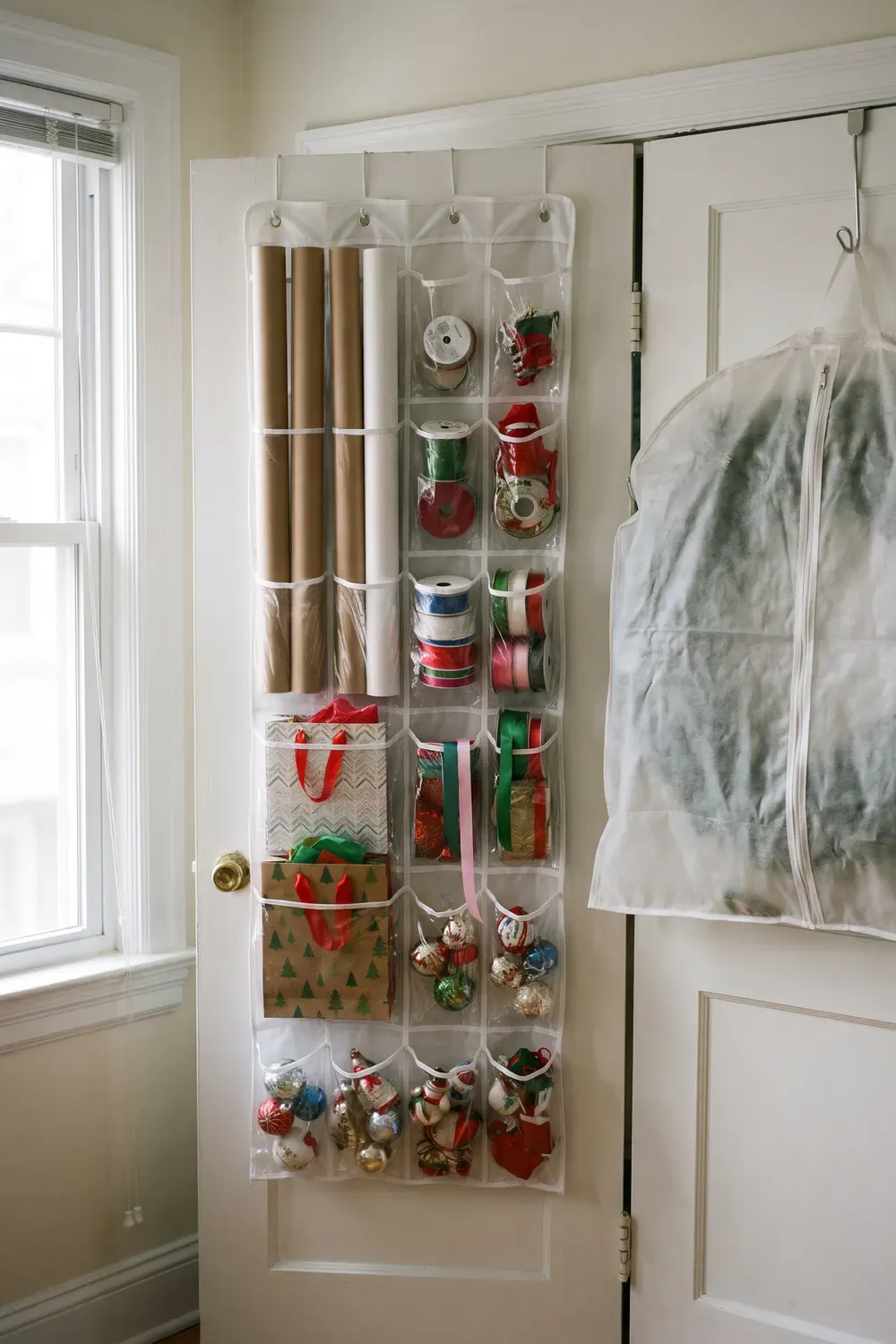
The back of a door is another underused spot. A clear over-the-door organizer holds wrapping paper, ribbon, gift bags, small ornaments and stocking hooks, and can stay up all year with other seasonal items in it. Over-the-door hooks are also good for hanging wreath bags. For more ideas, see our vertical storage ideas.
- Top closet shelf and above the wardrobe for once-a-year items
- A shelf insert to use the height above the closet shelf
- Over-the-door organizer for wrapping supplies and small decorations
5. Pack ornaments so they survive the year
Glass ornaments break when they knock against each other, so give each one its own space. Ornament storage boxes with cardboard or plastic dividers hold 24 to 64 ornaments and cost about $15 to $30. For a cheaper option, use egg cartons, plastic cups glued into a box or the divided cardboard from a case of wine glasses.
Wrap anything delicate or sentimental in tissue paper before it goes into a compartment, and avoid newspaper, which can transfer ink. Put the heaviest ornaments at the bottom and the lightest on top, and don’t overfill. A lid that has to be forced closed means pressure on everything inside.
Store ornament boxes on a shelf rather than under heavy bins, and mark the box as fragile on every side. Keep the hooks in a small bag or jar inside the box so you’re not hunting for them next year.
Tip: Take a quick photo of how a favorite ornament set fits in its box. It makes repacking in January much faster.
6. Store lights without tangles (and take out the batteries)
Test every strand of lights before you pack it away, and throw out any with frayed wires, cracked sockets or sections that won’t light. It’s much easier to sort this in January than to discover it on decorating day.
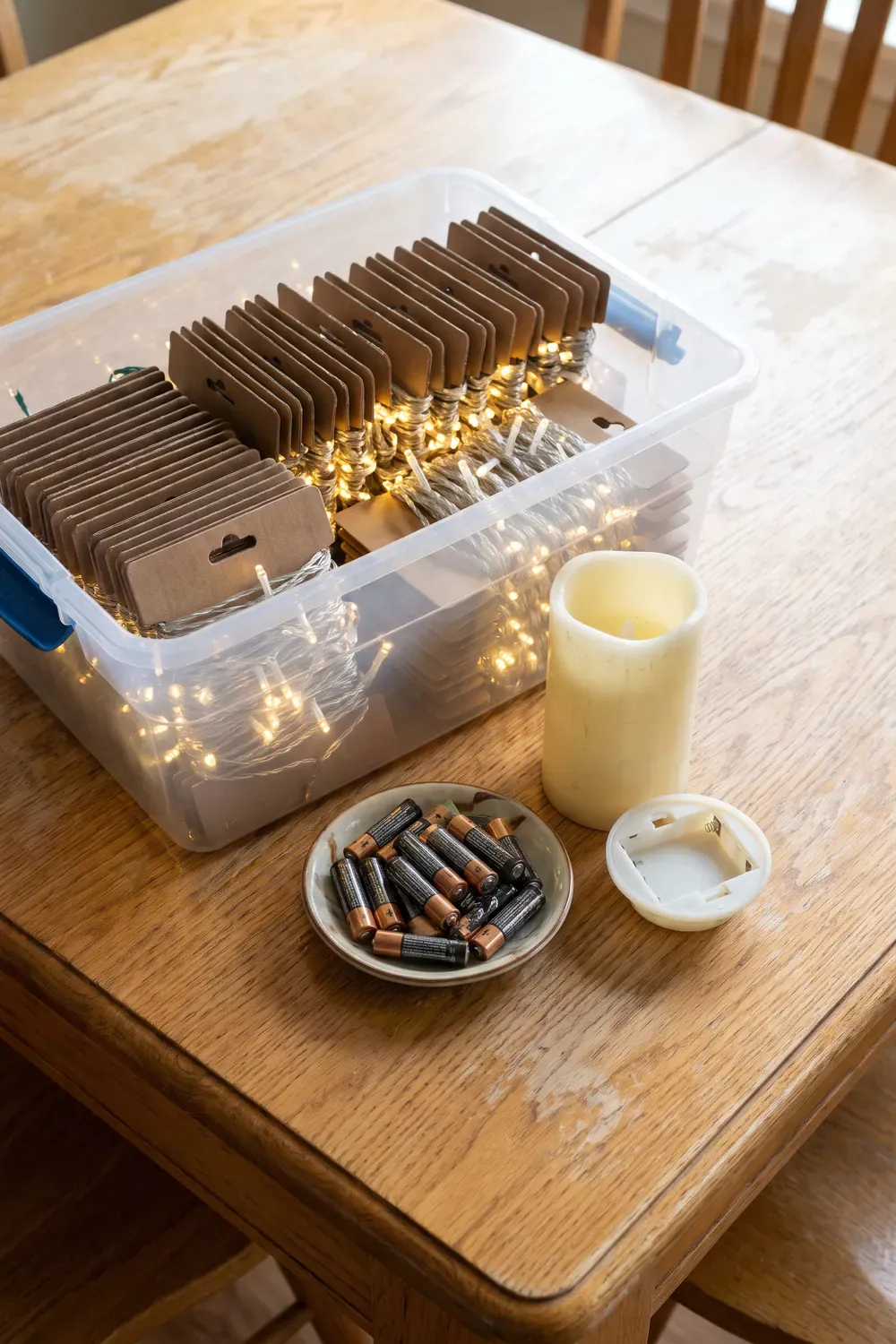
To prevent tangles, wind lights loosely around a rectangle of sturdy cardboard with a notch at each end to hold the plug and the end of the strand. Wrapping too tightly can pinch the wires. Cord reels and the original spools work too. Label each strand with its length and where it goes, such as tree, window or balcony, and keep spare bulbs, fuses and clips in a bag with the lights they belong to.
Remove the batteries from battery-operated decorations, including LED candles, light-up figurines and pre-lit wreaths and garlands. Batteries left in for a year can leak and corrode the contacts. Store them separately, and recycle any that are dead.
- Test every strand; discard damaged ones
- Wind loosely on notched cardboard or a reel
- Bag spare bulbs, fuses and clips with their lights
- Remove batteries from all battery-operated decor
7. Wreaths, garland and an artificial tree
Wreaths get crushed in bins, so store them flat or hanging. A round wreath storage bag or box costs about $10 to $25 and can hang on a hook inside a closet or slide flat onto a shelf or under the bed. Garland can be loosely coiled into a bin or wound around a cardboard tube from wrapping paper.
An artificial tree is often the largest item to store. Zippered tree storage bags are easier to fit into an apartment closet than the original cardboard box, which tends to split after a season or two. Slim trees can stand upright in a corner of the closet in an upright storage bag, and many take up less floor space than a small suitcase that way.
If you don’t have room for a full tree, consider a smaller tree next year. Our guide to choosing a Christmas tree for a small apartment covers slim, half and tabletop trees and how to plan their storage before you buy.
Tip: Fluff and shape the branches of an artificial tree before you bag it, and it will need less work next year.
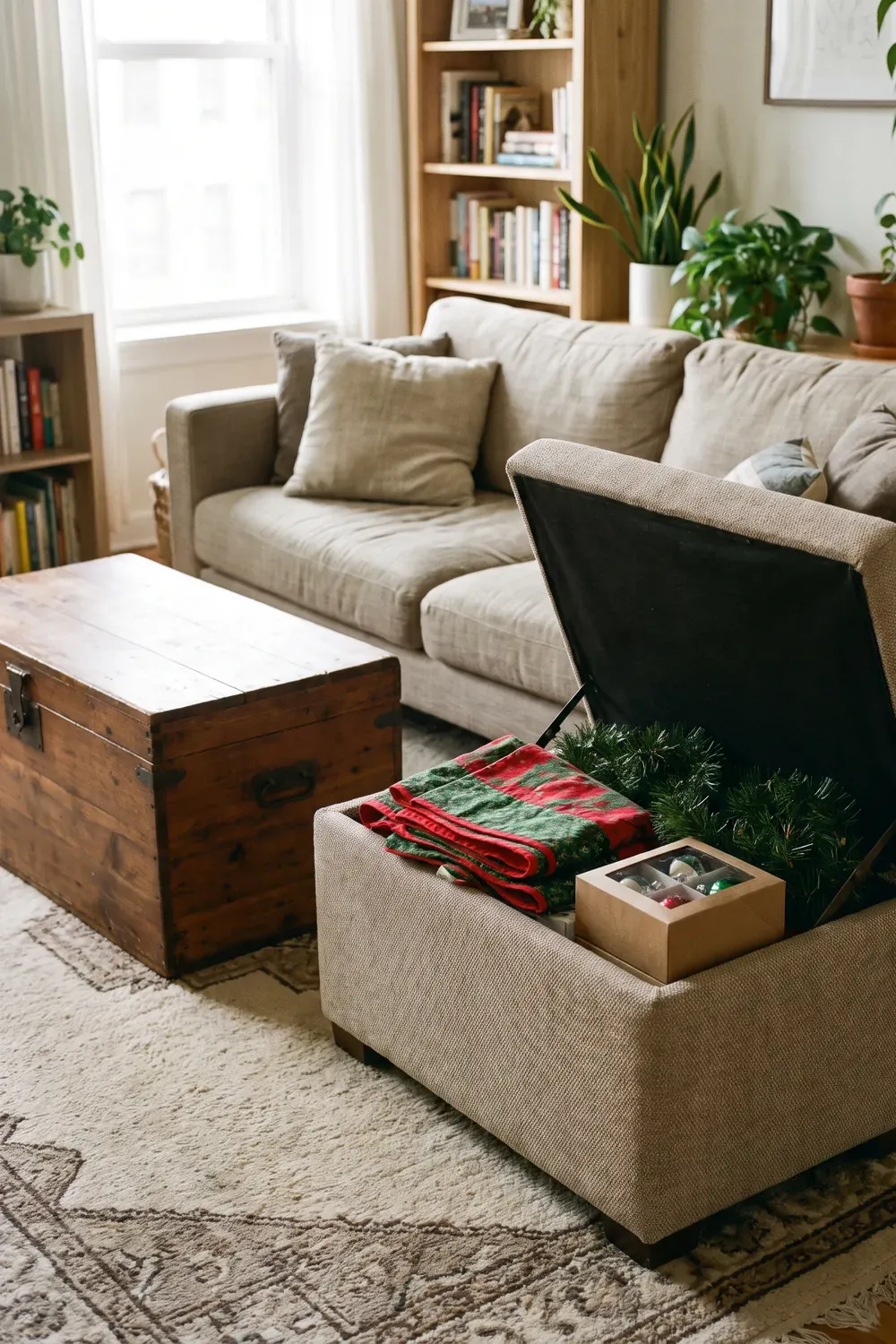
8. Hide decorations inside furniture
In a small apartment, furniture with storage inside does two jobs. A storage ottoman can hold garland, a tree skirt and a box of ornaments while serving as a footrest and extra seat. A storage bench at the foot of the bed or in the entryway holds stockings and table linens. A trunk or chest used as a coffee table can hold a whole season’s decorations.
Look for pieces with lids that lift easily and interiors deep enough for a standard ornament box. Fabric ottomans often cost $40 to $120, and secondhand trunks are easy to find. Line the inside with a fabric bag or a bin so dust stays out and you can lift everything out at once.
Don’t overload furniture people sit on. Heavy items belong at the bottom, and fragile ornaments are safer in a box inside than loose under a seat cushion. Our post on storage ottoman ideas has more ways to use them.
9. Keep decorations away from heat, damp and pests
Where you store decorations counts as much as how. Avoid spots next to radiators, heating vents or a sunny window, where heat can melt candles, warp plastic and fade fabric. Bathrooms and under-sink cabinets are too damp, and a balcony is exposed to cold, moisture and pests, so it’s not a good place for decorations even in a sealed bin.
A closet on an inside wall is usually the most stable spot in an apartment. Keep bins off the floor if your closet ever gets damp, and toss a few silica gel packets into bins with fabric or paper decorations to absorb moisture. Make sure everything is completely dry before it’s packed, especially if it was used outdoors.
Finally, make a simple list. A note on your phone with each bin’s contents and where it lives saves you from opening every bin next year. If you share the apartment, it also stops someone else from storing their things in the space you’ve planned.
- Away from radiators, vents and sunny windows
- Not in bathrooms, under sinks or on a balcony
- Silica gel packets in bins with fabric or paper
- A list of what’s in each bin and where it lives
Common questions
Where do you put Christmas decorations in an apartment with no storage?
Under the bed in shallow bins, on the top closet shelf, on the back of a door and inside storage furniture such as ottomans, benches and trunks.
What are the best containers for storing holiday decorations?
Clear plastic bins with snap-on lids, in sizes measured to fit your shelves and under-bed space. Use divided ornament boxes for glass ornaments and round bags for wreaths.
Should you store decorations in cardboard boxes?
Not for long. Cardboard absorbs moisture, attracts pests and crushes when stacked. Plastic bins protect decorations much better.
How do you store Christmas lights so they don’t tangle?
Test them, then wind them loosely around a notched piece of cardboard or a cord reel and keep spare bulbs with each strand.
Take photos of each bin’s contents as you pack and keep them on your phone; next year, you will know which box to open without unpacking all of them. Use the hidden spaces first, under the bed, high in the closet, behind the door and inside furniture, and keep decorations away from heat and damp.
Once your storage is sorted, the decorating is the fun part. Try these holiday decor ideas that don’t feel cramped, and use the same approach for clothes with our guide to storing winter clothes in a tiny apartment.